Space heater statistics tell a two-sided story. These small, cheap devices warm tens of millions of US homes, and they cause a share of home fire deaths far out of proportion to the heat they give. This page gathers the newest numbers from the groups that count them: the U.S. Consumer Product Safety Commission (CPSC), the National Fire Protection Association (NFPA), the Energy Information Administration (EIA), the CDC, medical journals, fire statistics for England and recall notices in the US and Canada.
Every number links to the report that first published it, with the date of the data. Where two agencies count differently, this page keeps their figures apart and says so. Fire counts are estimates built from fire department reports, so small gaps between CPSC and NFPA come from how each one groups heaters.
For HVAC techs and homeowners the useful question is why people reach for a plug-in heater at all. Often the main system is too small, too old or missing from one room. The data below shows how common that is and what it costs.
Key Takeaways
- Space heaters and heating stoves caused 30% of home heating fires in the U.S. but 73% of the deaths (NFPA, Dec 2025).
- An estimated 70 people a year died in U.S. home fires started by portable heaters from 2021 to 2023 (CPSC, Oct 2026).
- Portable heaters started about 1,600 U.S. home fires a year from 2021 to 2023, and 1,200 of them were electric models (CPSC, Oct 2026).
- NFPA’s main heater category started 3,310 home fires a year and killed 146 people a year from 2019 to 2023 (NFPA, Aug 2025).
- 25.08 million U.S. homes used a portable electric heater as secondary heat in 2020 (EIA, Mar 2023).
- Renters used portable electric heaters as main heat in 1.53 million homes in 2020, more than the 1.50 million owner homes that did, even though renters are the smaller group (EIA, Mar 2023).
- About 53,636 portable space heater burns were treated in U.S. emergency departments from 2003 to 2013 (Journal of Burn Care & Research, Jan 2017).
- Govee recalled about 512,500 smart electric space heaters after testing found they did not meet the UL 1278 safety standard (CPSC, Nov 2024).
- In England, space heating appliances started 747 accidental dwelling fires and 7 deaths in 2025/26, the fewest deaths in the 16-year series (MHCLG, Aug 2026).
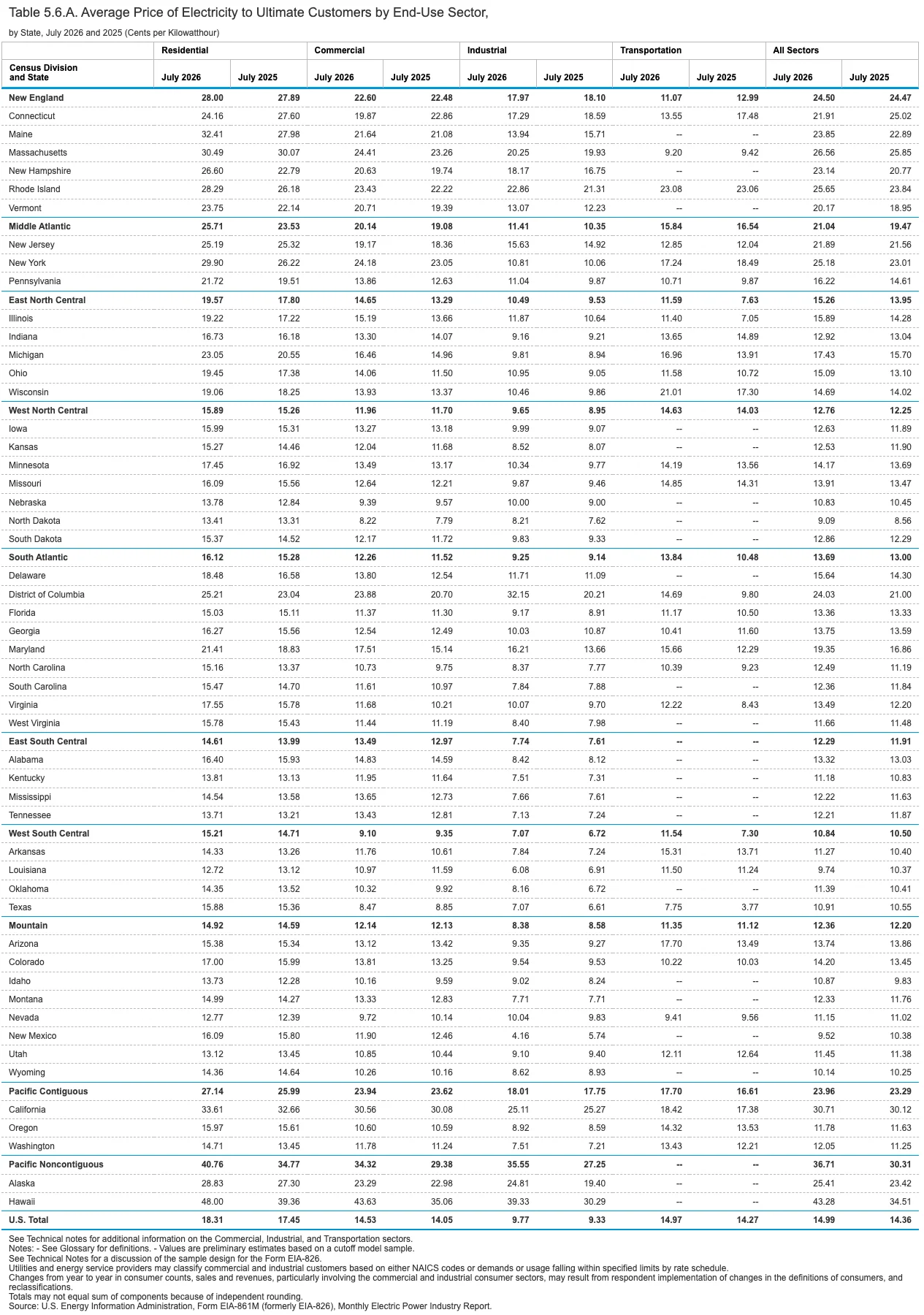
- Hawaii paid 48.00 cents per kilowatt-hour for electricity in July 2026, almost four times Louisiana’s 12.72 cents (EIA, Sep 2026).
- Portable heater fires fell from about 2,000 in 2015 to about 1,400 in 2023 (CPSC, Jul 2020; CPSC, Oct 2026).
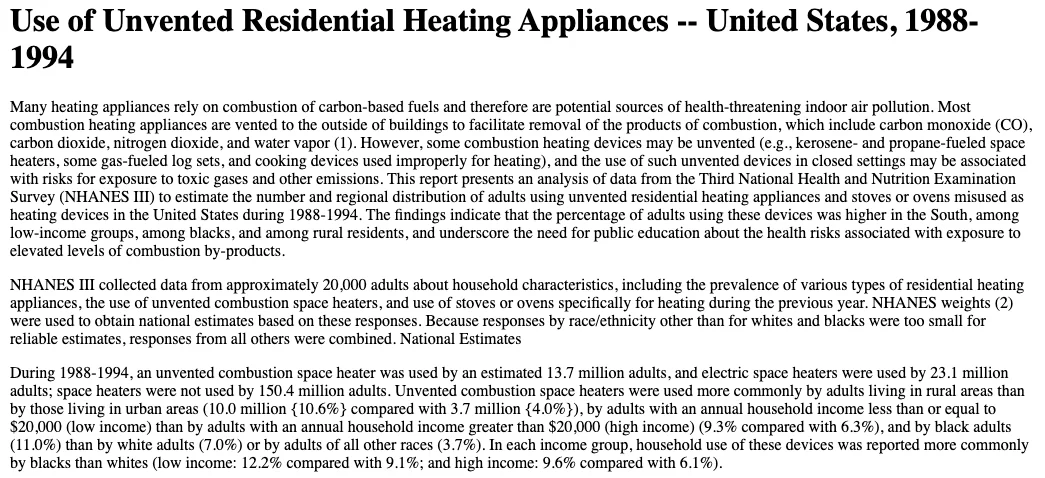
- An estimated 13.7 million U.S. adults used unvented combustion space heaters in 1988 to 1994 (CDC, Dec 1997).
- During California’s 2000 to 2001 power crisis, one burn center admitted 36 heater-related burn patients, against 25 to 29 in the other winters it studied (Archives of Surgery, Oct 2002).
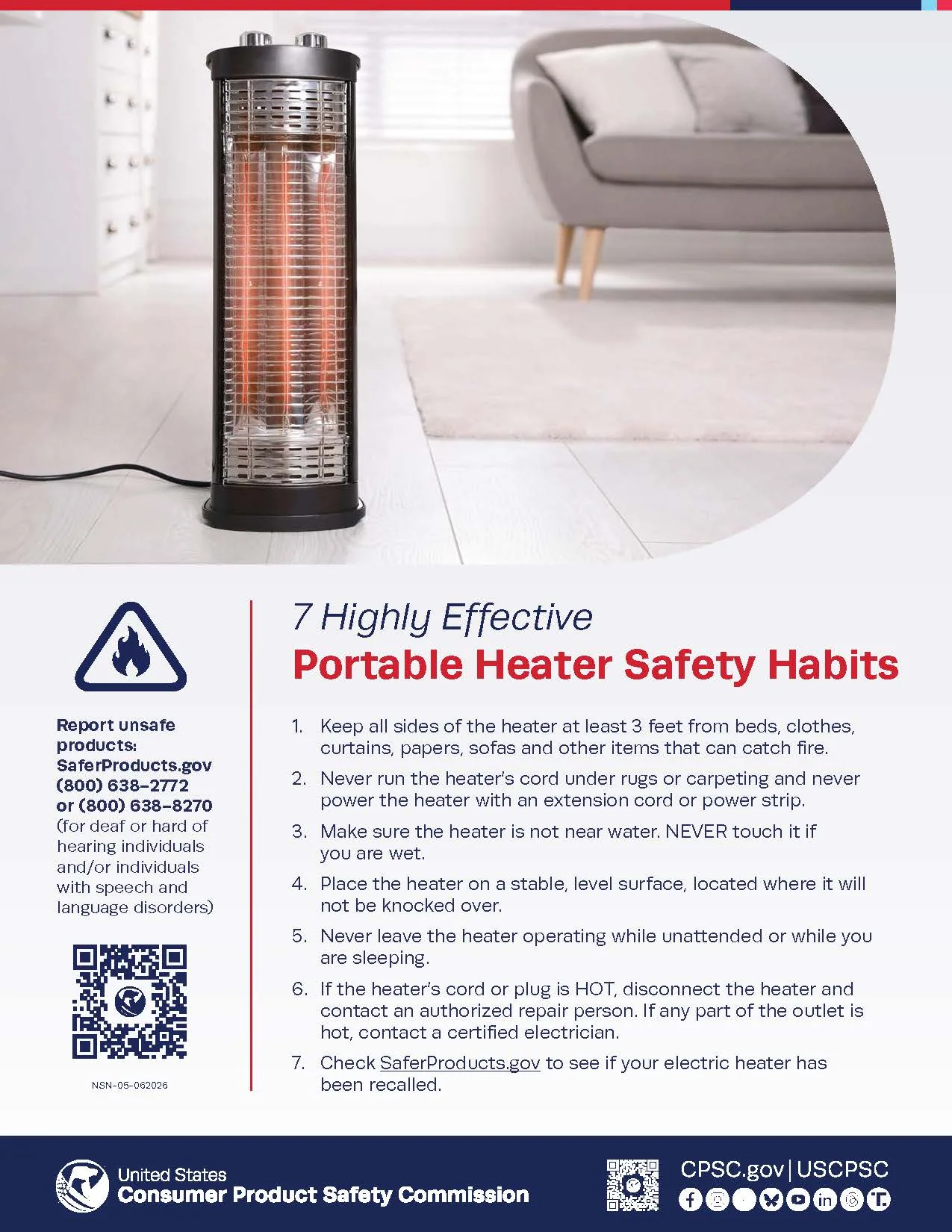
- CPSC’s first portable heater safety habit is to keep all sides at least 3 feet from beds, clothes, curtains, papers and sofas (CPSC, Jun 2026).
How many home fires do space heaters start each year?
Space heaters are a small slice of home fires and a large slice of the harm. The counts depend on who is counting and which heaters they include, so this section keeps the CPSC and NFPA numbers apart.
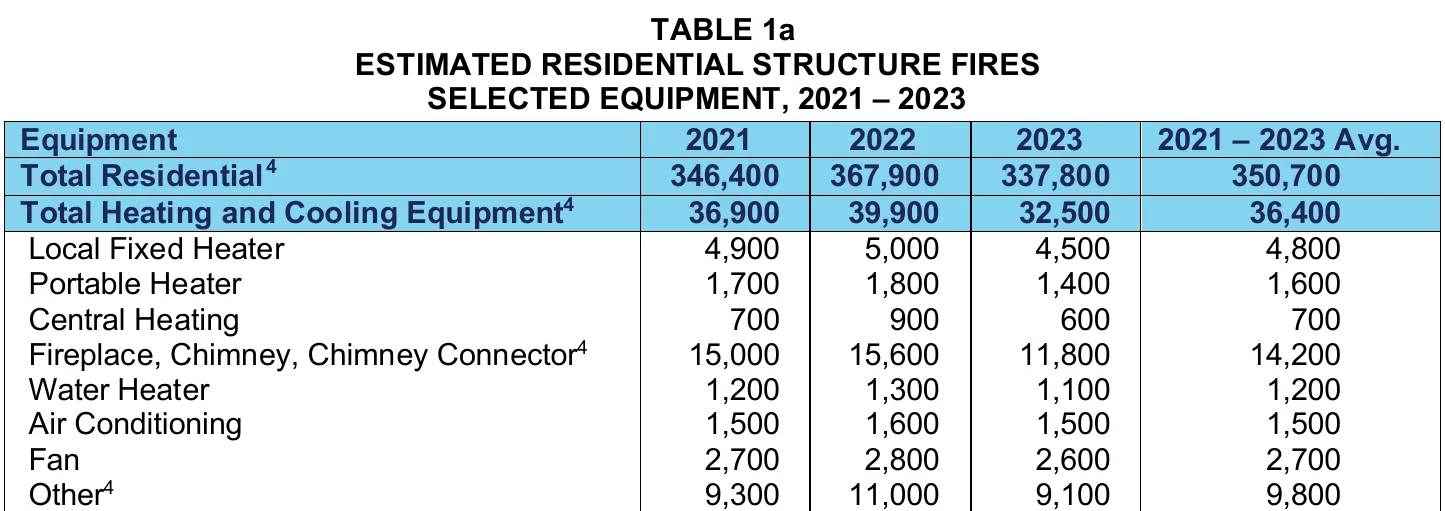
How many fires does CPSC link to portable and fixed heaters?
CPSC counts portable heaters apart from fixed heaters such as wall and baseboard units, and fixed units start about three times as many fires.
- Local fixed heaters started 4,800 home fires a year from 2021 to 2023 (CPSC, Oct 2026).
- Portable heater fires were estimated at 1,700 in 2021 and 1,800 in 2022 (CPSC, Oct 2026).
- All heating and cooling equipment together started 36,400 fires a year, which was 10.4% of residential fires (CPSC, Oct 2026).
- The same report put total residential structure fires at 350,700 a year (CPSC, Oct 2026).
- CPSC built its estimates from US Fire Administration and NFPA data and left out intentionally set fires (CPSC, Oct 2026).
How many fires does NFPA link to heaters?
NFPA splits heaters into three groups, and the standard group is by far the largest.
- Oil-filled heaters started 554 home fires a year from 2019 to 2023 (NFPA, Aug 2025).
- Catalytic heaters started 349 home fires a year over the same years (NFPA, Aug 2025).
- Heating stoves started 29,792 home fires a year, 9% of all home fires (NFPA, Aug 2025).
- Space heaters and heating stoves together caused 70% of the injuries in heating equipment home fires from 2020 to 2024 (NFPA, Dec 2025).
How many people do space heater fires kill, injure and cost?
A space heater fire is rare, but when it happens it is much more likely to kill than a typical home fire. NFPA’s table shows the gap in one line, and CPSC’s table shows the same pattern in its own count.
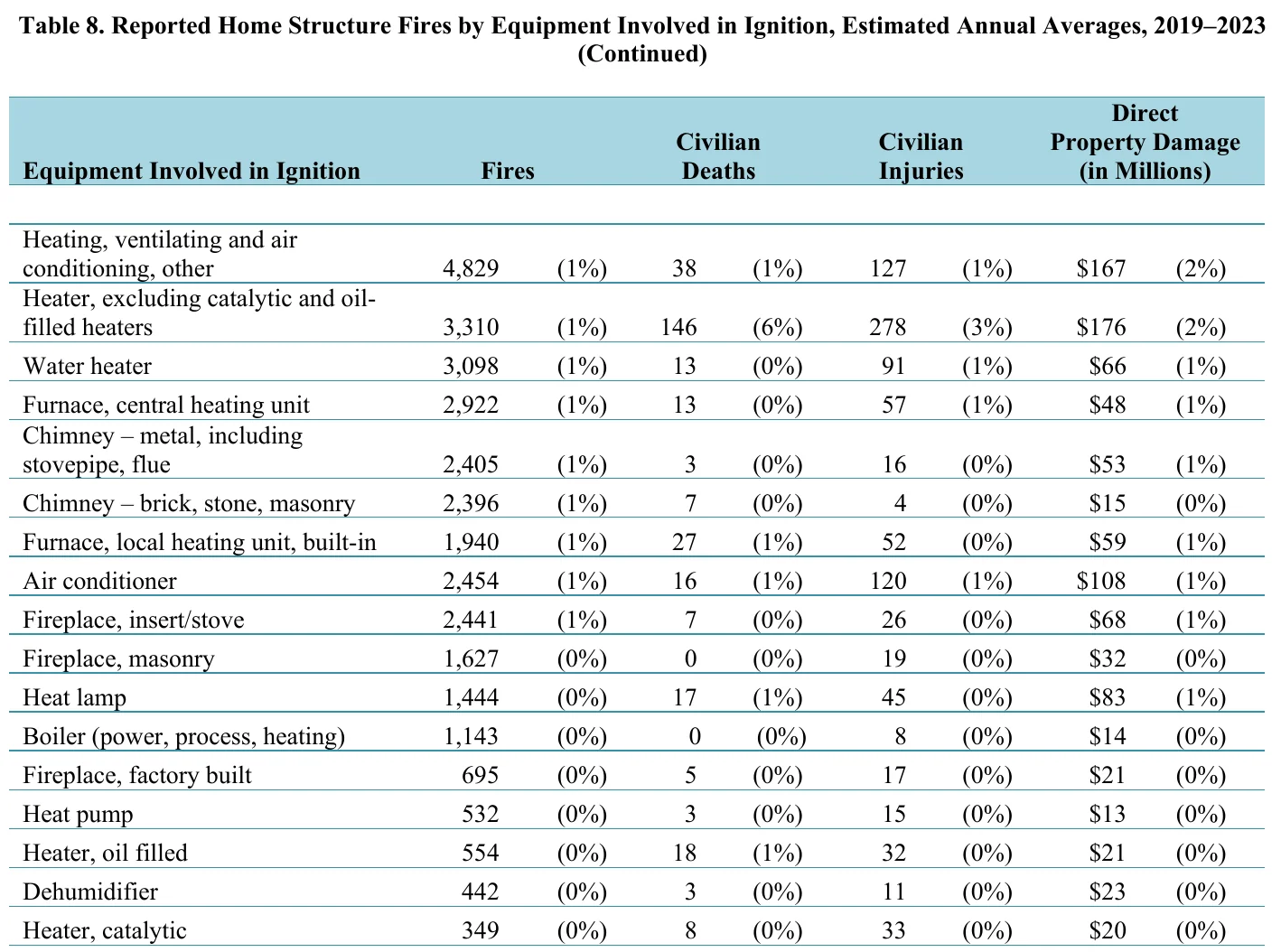
How many deaths do the fire agencies record?
CPSC and NFPA agree on the shape: heater fires are few and deadly.
- NFPA’s main heater category was 1% of home fires but 6% of home fire deaths from 2019 to 2023 (NFPA, Aug 2025).
- Portable heater fire deaths were estimated at 100 in 2021 and 60 in 2022 (CPSC, Oct 2026).
- Local fixed heaters caused 70 fire deaths a year from 2021 to 2023 (CPSC, Oct 2026).
- Oil-filled heaters were tied to 18 deaths a year and catalytic heaters to 8 (NFPA, Aug 2025).
- Heating stoves were tied to 160 deaths a year (NFPA, Aug 2025).
How many injuries do heater fires cause?
Injuries run a few times higher than deaths in every count.
- Portable heater fires injured an estimated 140 people a year from 2021 to 2023 (CPSC, Oct 2026).
- Local fixed heater fires injured an estimated 300 people a year (CPSC, Oct 2026).
- NFPA’s main heater category was tied to 278 civilian injuries a year, and oil-filled and catalytic heaters to 32 and 33 (NFPA, Aug 2025).
- Heating stoves were tied to 798 injuries a year (NFPA, Aug 2025).
How much property damage do they cause?
Dollar figures are smaller than for cooking or electrical fires, but they are not small for one product type.
- Portable heater fires caused $77.2 million a year in direct property loss from 2021 to 2023, not adjusted for inflation (CPSC, Oct 2026).
- Local fixed heater fires caused $163.3 million a year (CPSC, Oct 2026).
- NFPA’s main heater category caused $176 million a year in direct property damage, and oil-filled and catalytic heaters $21 million and $20 million (NFPA, Aug 2025).
- Heating stoves caused $316 million a year in direct property damage (NFPA, Aug 2025).
Which types of portable and fixed heaters start the most fires?
Electric heaters start most of the fires CPSC counts. Fuel-burning portables are rarer, but they kill more often per fire.
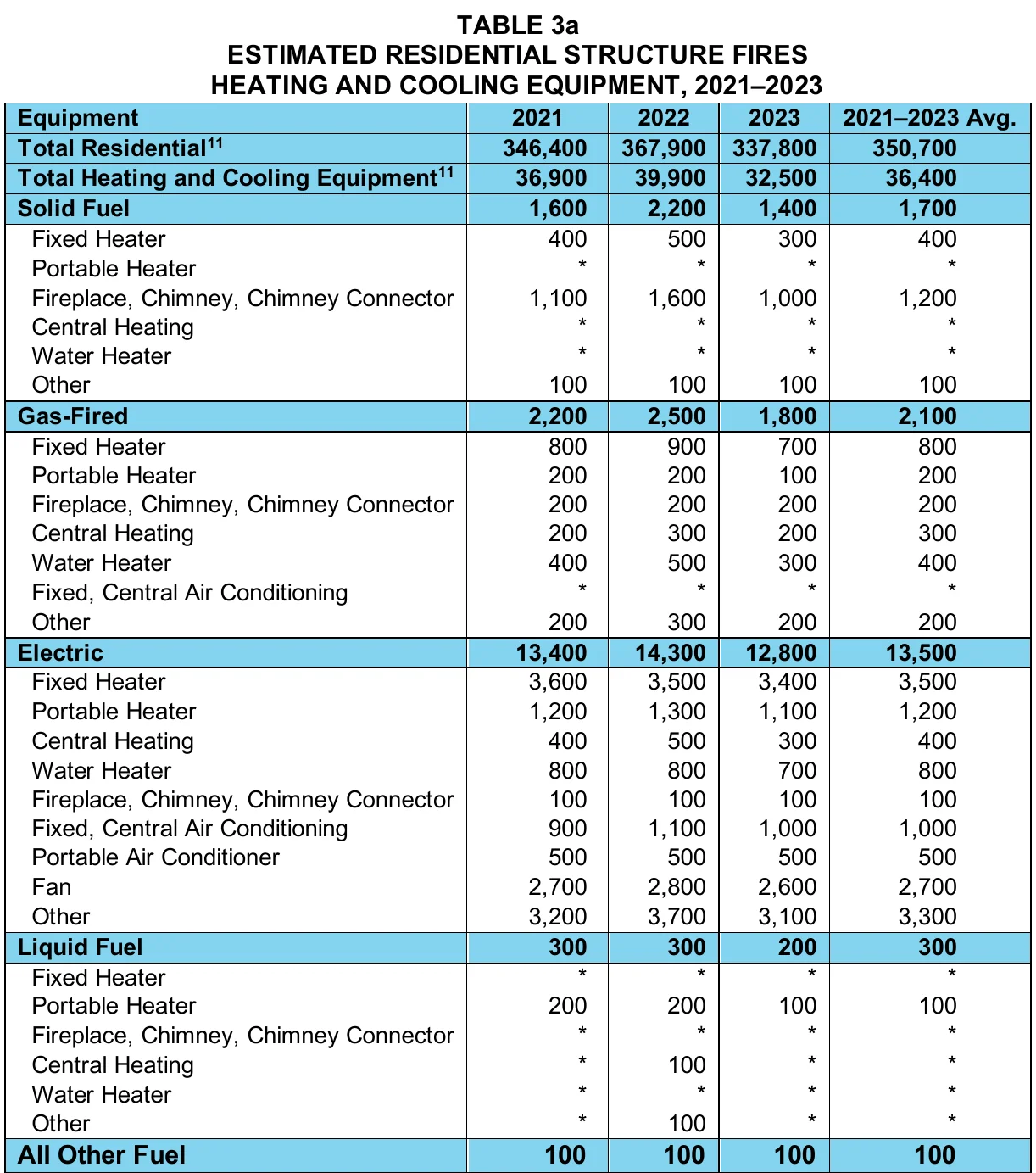
How do electric heaters compare?
Electric units dominate the counts for both portable and fixed heaters.
- Electric portable heaters were tied to 50 fire deaths and 100 injuries a year from 2021 to 2023 (CPSC, Oct 2026).
- Electric fixed heaters started 3,500 fires, caused 10 deaths and 210 injuries a year (CPSC, Oct 2026).
How do gas, liquid-fuel and solid-fuel heaters compare?
The fuel-burning types start fewer fires, but the death count for gas portable heaters is high for the number of fires.
- Gas-fired portable heaters started 200 fires, caused 20 deaths and 30 injuries a year (CPSC, Oct 2026).
- Gas-fired fixed heaters started 800 fires, caused 10 deaths and 60 injuries a year (CPSC, Oct 2026).
- Liquid-fuel portable heaters started 100 fires and injured 20 people a year (CPSC, Oct 2026).
- Solid-fuel fixed heaters started 400 fires and caused 40 deaths a year (CPSC, Oct 2026).
Are space heater fires going up or down in the US?
Heater fires are lower than a decade ago, but the line is not smooth. Deaths and dollar losses swing from year to year with a few large fires.
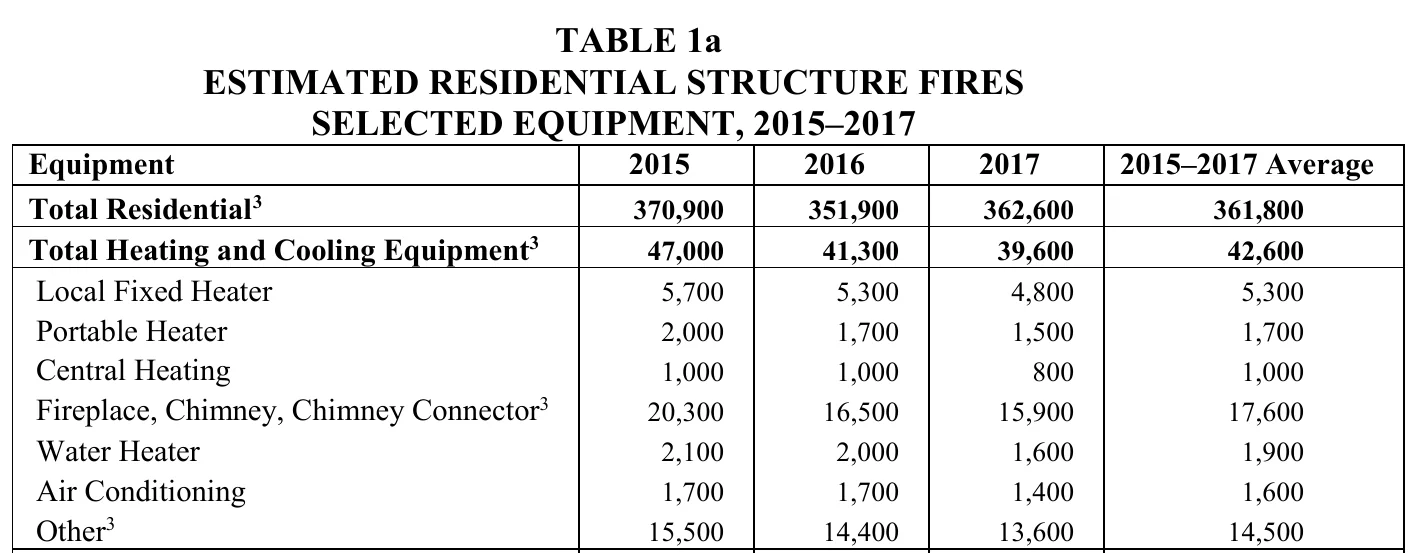
How did fires and deaths move before 2021?
The 2015 to 2020 reports show a dip in 2017, a jump back in 2018 and a low in 2020.
- Portable heater fires were estimated at 1,500 in 2017 (CPSC, Jul 2020).
- They were estimated at 2,000 in 2018 and 1,600 in 2019 (CPSC, Aug 2023).
- Portable heater fire deaths were 80 in 2015, 100 in 2016 and 60 in 2017 (CPSC, Jul 2020).
- Deaths averaged 70 a year from 2018 to 2020 (CPSC, Aug 2023).
- Portable heater fires injured an estimated 190 people in 2018 and 160 in 2019 (CPSC, Aug 2023).
How did property losses move?
Dollar losses are not adjusted for inflation, so they understate the later years against the earlier ones.
- Portable heater fires caused $101.7 million in property loss in 2015 and $44.4 million in 2017 (CPSC, Jul 2020).
- Losses were $80.1 million in 2018 and $53.2 million in 2019 (CPSC, Aug 2023).
- Losses reached $86.2 million in 2022 (CPSC, Oct 2026).
What do space heater fire statistics show for England?
England keeps a clean 16-year record of fires by source of ignition, and it shows heater fires falling faster than home fires as a whole.
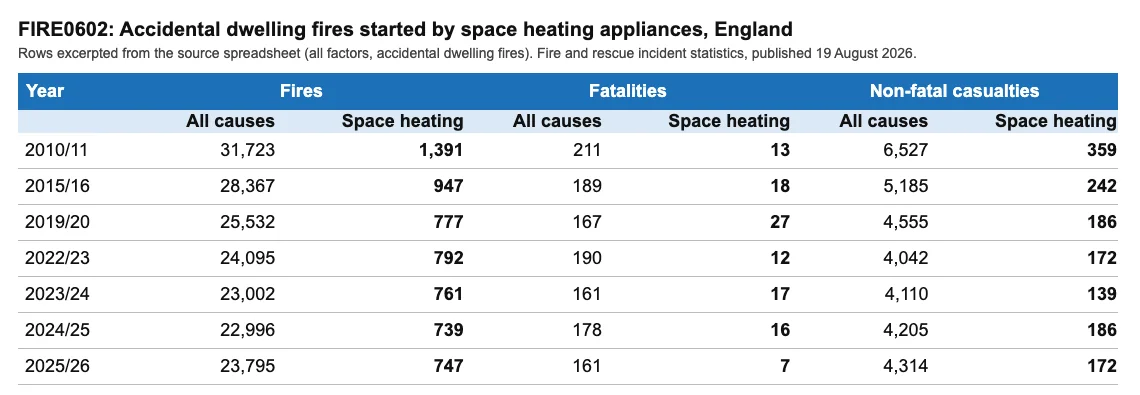
How many fires do space heating appliances start in England?
The figure counts accidental dwelling fires attended by fire and rescue services in England, by financial year.
- Space heating appliances started 1,391 accidental dwelling fires in 2010/11 (MHCLG, Aug 2026).
- The count was 947 in 2015/16 and 777 in 2019/20 (MHCLG, Aug 2026).
- It was 792 in 2022/23 and 739 in 2024/25 (MHCLG, Aug 2026).
- All accidental dwelling fires fell from 31,723 in 2010/11 to 23,795 in 2025/26 (MHCLG, Aug 2026).
- Cooking appliances started 9,928 accidental dwelling fires in 2025/26, more than thirteen times the heater count (MHCLG, Aug 2026).
How many deaths and casualties do they cause in England?
Deaths bounce more than fires because the numbers are small.
- Space heating appliances were tied to 13 deaths in 2010/11 (MHCLG, Aug 2026).
- Space heating appliances were tied to 27 deaths in each of 2016/17, 2017/18 and 2019/20, the highest count in the series (MHCLG, Aug 2026).
- The count was 16 deaths in 2024/25 (MHCLG, Aug 2026).
- In 2023/24 they started 761 fires and caused 139 non-fatal casualties (MHCLG, Aug 2026).
- All causes together killed 161 people in accidental dwelling fires in 2025/26 (MHCLG, Aug 2026).
- Non-fatal casualties from space heating fires fell from 359 in 2010/11 to 172 in 2025/26 (MHCLG, Aug 2026).
How many US homes use portable electric heaters?
The portable electric heater is the most common second heat source in American homes, ahead of fireplaces and heating stoves. EIA’s 2020 household survey is still the newest source for this, because the 2024 survey will not publish space heating tables until spring 2027.
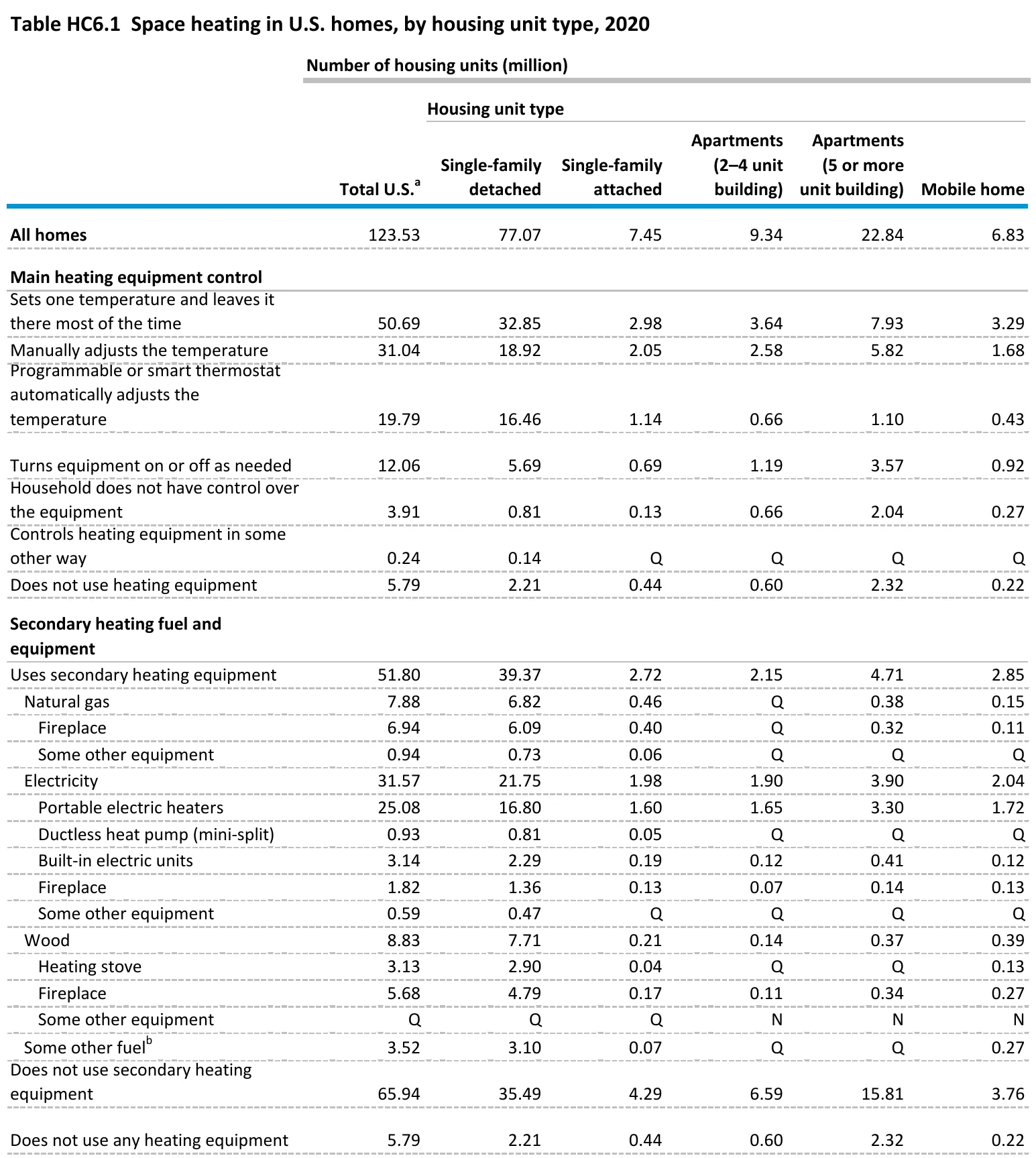
How many homes use them, and in what kind of home?
Most users live in detached houses, simply because most homes are detached houses.
- The survey covered 123.53 million U.S. homes (EIA, Mar 2023).
- Detached houses held 1.23 million of the homes that used portable electric heaters as main heat, and apartments in buildings of 5 or more units held 0.74 million (EIA, Mar 2023).
- Mobile homes held 0.60 million main-heat users (EIA, Mar 2023).
- As secondary heat, 16.80 million detached houses used portable electric heaters (EIA, Mar 2023).
- 3.30 million apartments in larger buildings and 1.72 million mobile homes did the same (EIA, Mar 2023).
- Natural gas fireplaces were the next most common secondary heat source at 6.94 million homes, then wood fireplaces at 5.68 million and heating stoves at 3.13 million (EIA, Mar 2023).
Do owners or renters use them more?
Owners use more portable heaters in total, because there are more owner homes.
- Owner-occupied homes used portable electric heaters as secondary heat in 17.73 million cases, and renter-occupied homes in 7.36 million (EIA, Mar 2023).
- The survey counted 82.92 million owned homes and 40.61 million rented homes (EIA, Mar 2023).
- Rented apartments accounted for 4.23 million secondary heater users (EIA, Mar 2023).
How big are the households that use them?
One- and two-person households account for most users.
- One-person households used portable electric heaters as secondary heat in 6.23 million cases and two-person households in 8.85 million (EIA, Mar 2023).
- Households of five or more people did so in 2.26 million cases (EIA, Mar 2023).
Who relies on portable heaters most by climate, home size and income?
Portable heaters follow the weather, but they follow small and older homes more.
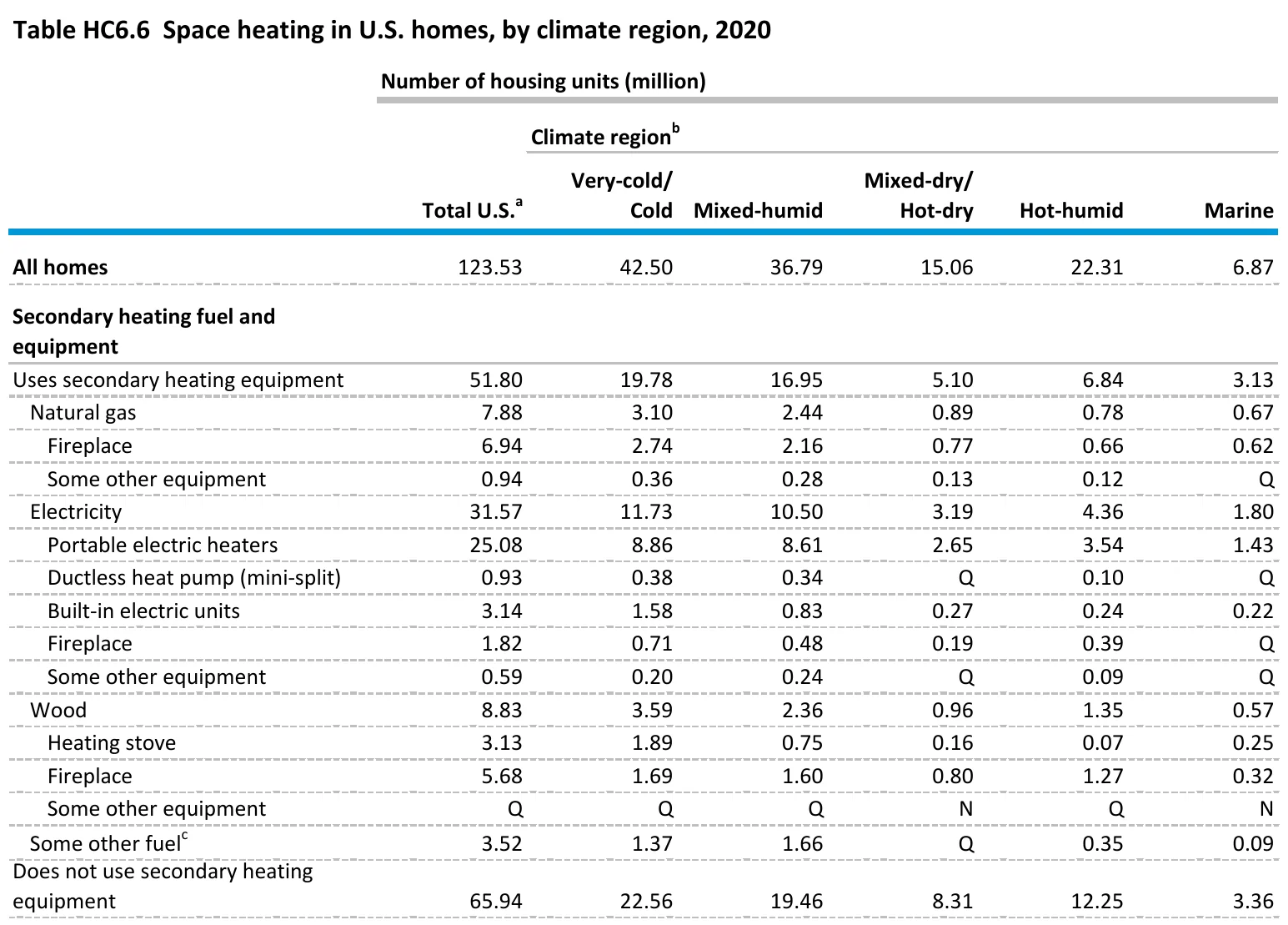
How does climate change who uses them?
The cold and mixed climates have the most users as secondary heat, but the hot-humid region has the most as main heat.
- 8.86 million homes in the very-cold and cold region used portable electric heaters as secondary heat, and 8.61 million in the mixed-humid region (EIA, Mar 2023).
- The hot-humid region had 3.54 million secondary users, the mixed-dry and hot-dry region 2.65 million and the marine region 1.43 million (EIA, Mar 2023).
- As main heat, the hot-humid region had 0.98 million homes with portable electric heaters, against 0.22 million in the very-cold and cold region (EIA, Mar 2023).
- 20.18 million homes used any secondary heating only when it was very cold (EIA, Mar 2023).
Do home size, age and income matter?
Home size and age show a clear pattern. Income counts mostly follow the number of households in each band.
- 1.50 million homes under 1,000 square feet used portable electric heaters as main heat, against 0.10 million homes of 2,500 to 2,999 square feet (EIA, Mar 2023).
- 5.37 million homes under 1,000 square feet used them as secondary heat, and 3.18 million homes of 3,000 square feet or more did the same (EIA, Mar 2023).
- Homes of 1,000 to 1,499 square feet had 5.85 million secondary users (EIA, Mar 2023).
- Homes built before 1950 accounted for 5.44 million secondary users, against 0.71 million homes built from 2016 to 2020 (EIA, Mar 2023).
- Homes built before 1950 also accounted for 0.63 million main-heat users (EIA, Mar 2023).
- Households earning $20,000 to $39,999 accounted for 0.80 million main-heat users, the most of any income band (EIA, Mar 2023).
- Households earning $150,000 or more accounted for 2.97 million secondary users (EIA, Mar 2023).
- Households earning $60,000 to $99,999 accounted for 6.01 million secondary users, the most of any income band (EIA, Mar 2023).
A room that needs a plug-in heater to stay comfortable often has a heat load the duct system or the old equipment was never sized for. A mini split sizing calculator gives a first estimate for one zone. The cost side of home heating is covered in energy poverty statistics.
How many burns and injuries do portable heaters cause?
Medical records show a different harm than fire reports: burns to the hands, and a burst of severe burns when an energy crisis pushed people toward heaters.
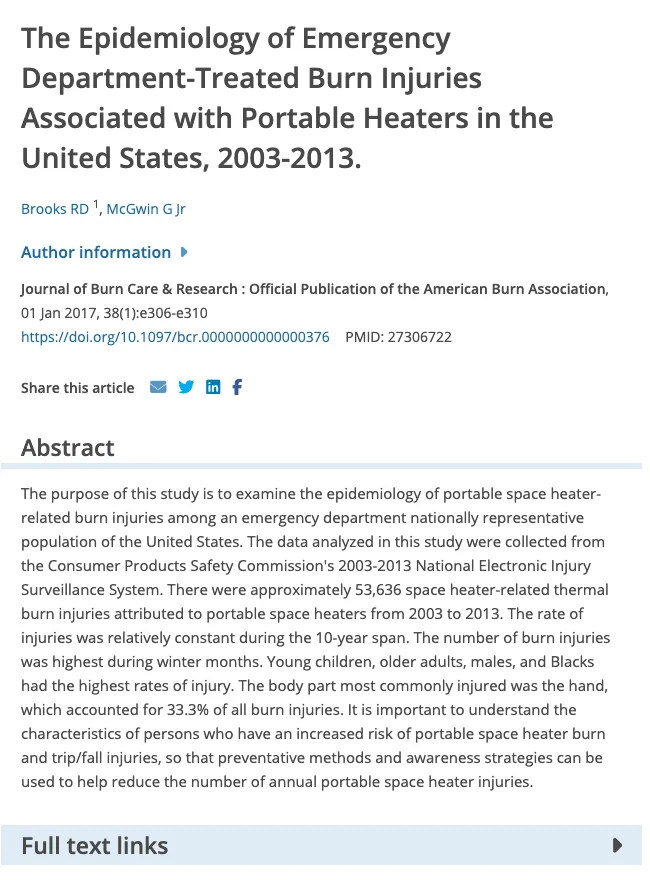
Who gets burned in US emergency departments?
A study of the CPSC injury surveillance system gives the national picture for 2003 to 2013.
- The hand was the body part injured most often, in 33.3% of portable space heater burns (Journal of Burn Care & Research, Jan 2017).
- The rate of injuries stayed about the same over the 10 years and peaked in winter (Journal of Burn Care & Research, Jan 2017).
- Young children, older adults, males and Black patients had the highest injury rates (Journal of Burn Care & Research, Jan 2017).
- A 10-year review of burns in people aged 65 and over found heaters and heating systems among the top five causes in men (Journal of Burn Care & Research, Feb 2021).
What happened in a burn center during an energy crisis?
A California burn center compared four winters, one of them during the 2000 to 2001 power shortages and price rises.
- The center admitted 512 burn patients across the four winters studied (Archives of Surgery, Oct 2002).
- Across all burn admissions in the crisis winter, the mean burn size was 24.0% of body surface, against 16.5%, 12.3% and 12.0% in the other three winters (Archives of Surgery, Oct 2002).
- The mean hospital stay was 15.0 days in the crisis winter, against 9.9, 12.3 and 7.0 days (Archives of Surgery, Oct 2002).
- The center performed 55 operations in the crisis winter, against 7, 18 and 19 (Archives of Surgery, Oct 2002).
Who is most at risk in home fires generally?
CPSC’s age table covers all home fires, not only heater fires, but it shows who is hurt when a fire starts.
- The fire death rate was 0.7 per 100,000 people from 2021 to 2023 (CPSC, Oct 2026).
- It was 1.6 per 100,000 for people aged 65 to 74 and 2.1 for people aged 75 and over (CPSC, Oct 2026).
Which space heaters have been recalled, and how many units were sold?
The big recalls share a pattern: low-cost electric heaters that overheat, often sold online and often in the hundreds of thousands.
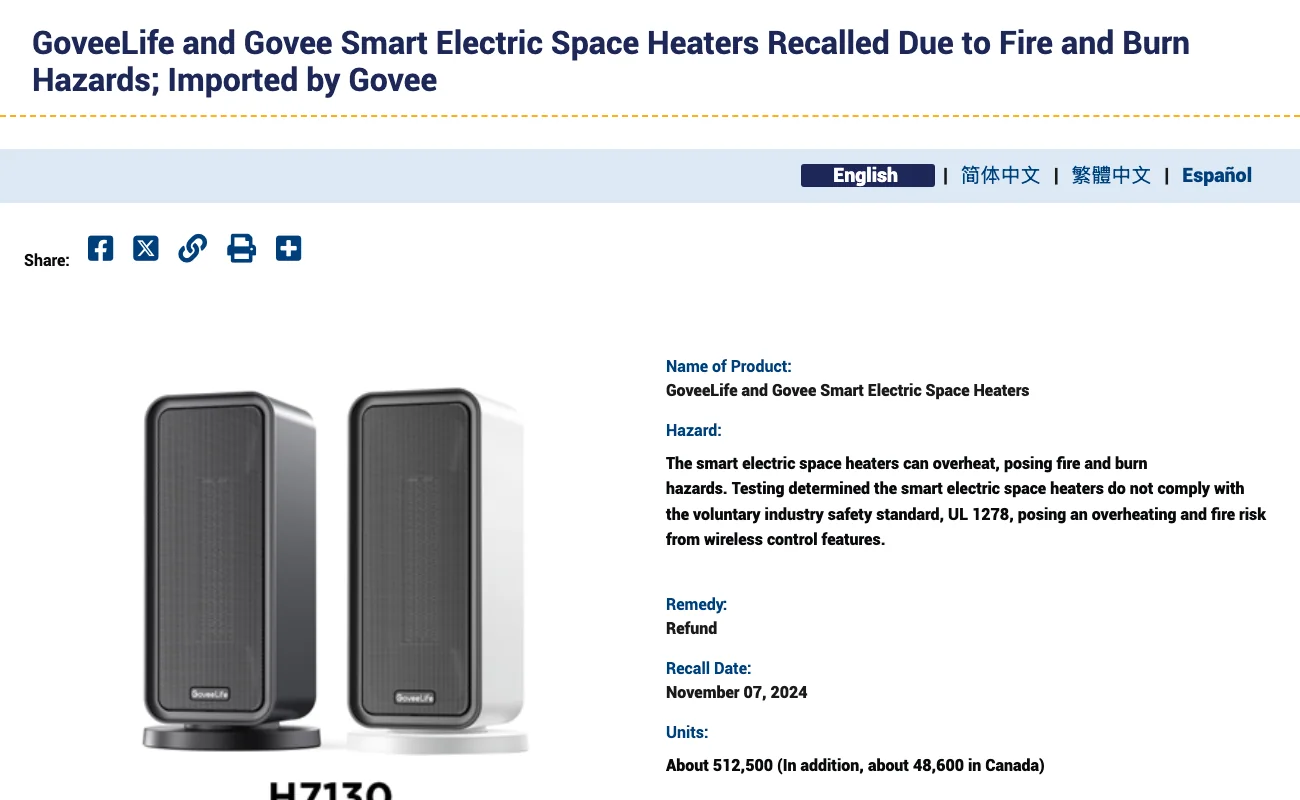
Which US recalls were the largest?
CPSC recall pages give units sold, the hazard and the reports received.
- Sienhua Group recalled about 580,000 WarmWave and Hunter ceramic tower heaters because the cord and plug can overheat (CPSC, Jun 2022).
- The firm had received eight reports of fire at the plug or cord and dozens of reports of overheating (CPSC, Jun 2022).
- Amazon recalled about 377,000 AmazonBasics ceramic space heaters (CPSC, Jun 2019).
- Vornado recalled about 350,000 VH101 personal vortex heaters, and in the Aug 2018 update it reported 19 reports of fire, including one fire that killed a 90-year-old man in December 2017 (CPSC, Aug 2018).
- Vornado’s SRTH small room tower heater recall covered about 255,000 units sold from August 2013 to May 2026 (CPSC, Jun 2026).
- That recall followed 32 reports of overheating, including eight fires (CPSC, Jun 2026).
- The Govee recall followed 113 reports of overheating, including seven fires and one minor burn (CPSC, Nov 2024).
- Atomi recalled about 99,400 smart heaters that can turn on without user input (CPSC, Jul 2024).
- Heat Hero recalled about 20,000 plug-in heaters after 117 reports of overheating, including 10 fires (CPSC, Apr 2019).
What did Health Canada record?
Health Canada reports units sold in Canada, which are often small next to the US count.
- Health Canada counted 14,764 WarmWave and 22,816 Hunter heaters sold in Canada (Health Canada, Jun 2022).
- It counted about 48,584 Govee heaters sold in Canada, with 7 reports of overheating and none of injury (Health Canada, Nov 2024).
- It counted 10,700 Atomi smart heaters sold in Canada from October 2020 to April 2024 (Health Canada, Jul 2024).
- It counted 154 Danby heaters sold in Canada from November 2022 to March 2023 (Health Canada, Aug 2023).
- It warned about the Simnoble mini ceramic heater sold on Amazon.ca, with 852 units sold between July 2022 and September 2023 and one fire reported (Health Canada, Nov 2024).
Which fuel-burning heater recalls matter?
Two 2025 and 2026 recalls cover propane heaters and kerosene fuel.
- Enerco recalled about 21,250 DEWALT 70,000 BTU propane heaters after 11 reports of overheating (CPSC, Apr 2025).
- Alliance Chemical recalled about 30,155 containers of 1-K kerosene heater fluid because they lack required flame mitigation devices (CPSC, Apr 2026).
How much does it cost to run a space heater?
A plug-in electric heater turns every kilowatt-hour it draws into heat, so the cost depends on its watts and on your local rate. Rates differ widely across the states.
What do electricity rates look like?
State rates run from the low teens to the high forties.
- California paid 33.61 cents per kilowatt-hour in July 2026 and Massachusetts 30.49 cents (EIA, Sep 2026).
- New York paid 29.90 cents and Illinois 19.22 cents (EIA, Sep 2026).
- Texas paid 15.88 cents and Florida 15.03 cents (EIA, Sep 2026).
How many watts do heaters draw?
Several recalled plug-in models were rated at 1,500 watts, and smaller ones far less.
- The AmazonBasics heaters in the 2019 recall were rated at 1,500 watts (CPSC, Jun 2019).
- The recalled Danby oscillating heater was also rated at 1,500 watts (Health Canada, Aug 2023).
- The recalled Heat Hero mini heaters were rated at 350 watts (CPSC, Apr 2019).
- The recalled Cadet Apex72 wall heaters were rated between 1,200 and 1,600 watts (CPSC, Sep 2024).
Our arithmetic, not a citation: a 1,500 watt heater on high draws 1.5 kilowatt-hours an hour. At the Texas rate above that is about 24 cents an hour, or about $1.91 for 8 hours. At the California rate the same hour costs about 50 cents, and at the Hawaii rate 72 cents. A heater that has to run all day is a sign that the room loses more heat than the main system supplies. A BTU calculator estimates that load. The national picture of what heating and cooling use is in HVAC energy consumption statistics.
What health risks come with unvented fuel-burning heaters?
Kerosene and propane heaters without a vent put combustion gases into the room. The national survey data is old, but it is still the best count of who uses them, and the lab data is newer.
How many people used them?
The survey asked about use over the previous year.
- Electric space heaters were used by an estimated 23.1 million adults in 1988 to 1994, and no space heater by 150.4 million (CDC, Dec 1997).
- Unvented combustion heaters were used by 10.0 million rural adults (10.6%) and 3.7 million urban adults (4.0%) (CDC, Dec 1997).
- Use ranged from 13.2% of adults in the South to 2.5% in the West (CDC, Dec 1997).
- Adults in households earning $20,000 or less used them at 9.3%, against 6.3% in higher-income households (CDC, Dec 1997).
- Use was 5.9% in the Midwest and 4.2% in the Northeast (CDC, Dec 1997).
- Low-income households in the South used them at 16.3%, against 11.2% for high-income households in the South (CDC, Dec 1997).
- Black adults used them at 11.0% and white adults at 7.0% (CDC, Dec 1997).
- Of 83.1 million adults who cooked with a gas stove or oven, 7.7 million (9.3%) had used it for heat in the past year (CDC, Dec 1997).
What do they release into a room?
A French chamber test of two recent kerosene heaters gives emission rates per gram of fuel.
- Nitrogen dioxide came out at 100 to 450 micrograms per gram of fuel burned (Indoor Air, Aug 2012).
- Carbon monoxide came mostly in the first minutes of use, at up to 3 milligrams per gram (Indoor Air, Aug 2012).
- Soot buildup on a wick heater raised the carbon monoxide rate to as much as 16 milligrams per gram (Indoor Air, Aug 2012).
- The wick heater emitted formaldehyde at 15 micrograms per gram and benzene at 16 micrograms per gram (Indoor Air, Aug 2012).
- NFPA notes that newer unvented gas heaters have an oxygen depletion sensor but still produce carbon monoxide, carbon dioxide and nitrogen dioxide (NFPA, Aug 2026).
CPSC’s counts of carbon monoxide deaths from heaters and other products are in carbon monoxide poisoning statistics.
What do safety agencies say about using a space heater?
The rules are short, and most aim at the same three causes: things too close, too much load on the outlet and nobody watching.
How should a heater be placed and powered?
Both agencies tell users to plug heaters straight into a wall outlet.
- CPSC lists seven habits for portable heaters (CPSC, Jun 2026).
- CPSC says never to power a heater with an extension cord or power strip and never to run its cord under rugs (CPSC, Jun 2026).
- NFPA says not to plug anything else into the same wall outlet as a space heater (NFPA, Aug 2026).
- NFPA recommends heaters listed by a nationally recognized testing laboratory and with an automatic shut-off if tipped over (NFPA, Aug 2026).
- NFPA recommends a 3-foot safety zone around heating equipment for kids and pets (NFPA, Aug 2026).
When should a heater be off?
Time and attention matter as much as distance.
- CPSC says never to leave a heater operating while unattended or while you are sleeping (CPSC, Jun 2026).
- CPSC says to disconnect a heater if the cord or plug is hot and to call an electrician if any part of the outlet is hot (CPSC, Jun 2026).
- CPSC says to check SaferProducts.gov to see whether an electric heater has been recalled (CPSC, Jun 2026).
- In a February 2026 winter storm warning CPSC added that a portable heater should never run unattended in a confined space, to reduce hyperthermia hazards (CPSC, Feb 2026).
- NFPA says fuel-burning heaters should be refueled outside after they cool, and warns that portable kerosene heaters are illegal in some communities (NFPA, Aug 2026).
Methodology and Sources
Each statistic comes from the agency, regulator, research body or journal that first published it, and each link points to that report or page. Fire figures are national estimates built from fire department reports and are rounded by their publishers, so CPSC and NFPA counts differ and are never blended. The EIA household figures are from the 2020 survey, the latest to publish space heating tables. The one table in Figure 5 is a set of rows from the English fire statistics spreadsheet, set as a table by us. The cost arithmetic in the running cost section is ours and is not counted as a citation. The page is refreshed monthly.
Glossary
- CPSC: the U.S. Consumer Product Safety Commission.
- NFPA: the National Fire Protection Association, a US fire safety group that estimates national fire losses.
- EIA: the U.S. Energy Information Administration.
- RECS: the Residential Energy Consumption Survey run by EIA.
- MHCLG: the UK Ministry of Housing, Communities and Local Government, which now publishes English fire statistics.
- UL 1278: the voluntary safety standard for movable and wall or ceiling-hung electric room heaters.
- kWh: kilowatt-hour, the unit electricity is sold in.
- BTU: British thermal unit, a unit of heat.
- Unvented heater: a fuel-burning heater with no flue, so its exhaust enters the room.
- TBSA: total body surface area, the share of skin burned.
Sources
- CPSC, 2021 to 2023 Residential Fire Loss Estimates
- CPSC, 2018 to 2020 Residential Fire Loss Estimates
- CPSC, 2015 to 2017 Residential Fire Loss Estimates
- CPSC, 7 Highly Effective Portable Heater Safety Habits
- CPSC, Winter Storm May Knock Out Power
- CPSC, Vornado SRTH recall
- CPSC, Govee recall
- CPSC, Atomi recall
- CPSC, WarmWave and Hunter recall
- CPSC, AmazonBasics recall
- CPSC, Vornado re-announced recall
- CPSC, Heat Hero recall
- CPSC, Glen Dimplex Cadet recall
- CPSC, Enerco DEWALT propane heater recall
- CPSC, Alliance Chemical kerosene heater fluid recall
- NFPA, Safety with heating equipment
- NFPA, Home Structure Fires: Supporting Tables
- NFPA, Educational Messages Desk Reference, 2026 edition
- EIA, RECS 2020 Table HC6.1
- EIA, RECS 2020 Table HC6.2
- EIA, RECS 2020 Table HC6.3
- EIA, RECS 2020 Table HC6.4
- EIA, RECS 2020 Table HC6.5
- EIA, RECS 2020 Table HC6.6
- EIA, RECS 2020 Table HC6.9
- EIA, Electric Power Monthly Table 5.6.A
- MHCLG, Fire statistics table FIRE0602
- CDC, Use of Unvented Residential Heating Appliances, MMWR
- Brooks and McGwin, Journal of Burn Care & Research
- Sen and colleagues, Journal of Burn Care & Research
- Palmieri and Greenhalgh, Archives of Surgery
- Carteret and colleagues, Indoor Air
- Health Canada, WarmWave and Hunter recall
- Health Canada, Govee recall
- Health Canada, Atomi recall
- Health Canada, Danby recall
- Health Canada, Simnoble warning