Updated October 2026.
Furnace statistics describe a large, old market that is about to change. US makers shipped 3,150,713 gas and oil warm air furnaces in 2024 (AHRI, Feb 2026).
This page follows the furnace from the sales floor to the end of its life. It covers sales, efficiency, lifespan, cost, rules, safety and sizing. Every number comes from the agency, trade body, court or company that produced it, and every link opens the source.
Some figures conflict, and the page says so. DOE and gas and propane trade groups disagree on how much of the market is already condensing. Sales data and the rule timeline also move month to month, so this page is refreshed monthly.
Key Takeaways
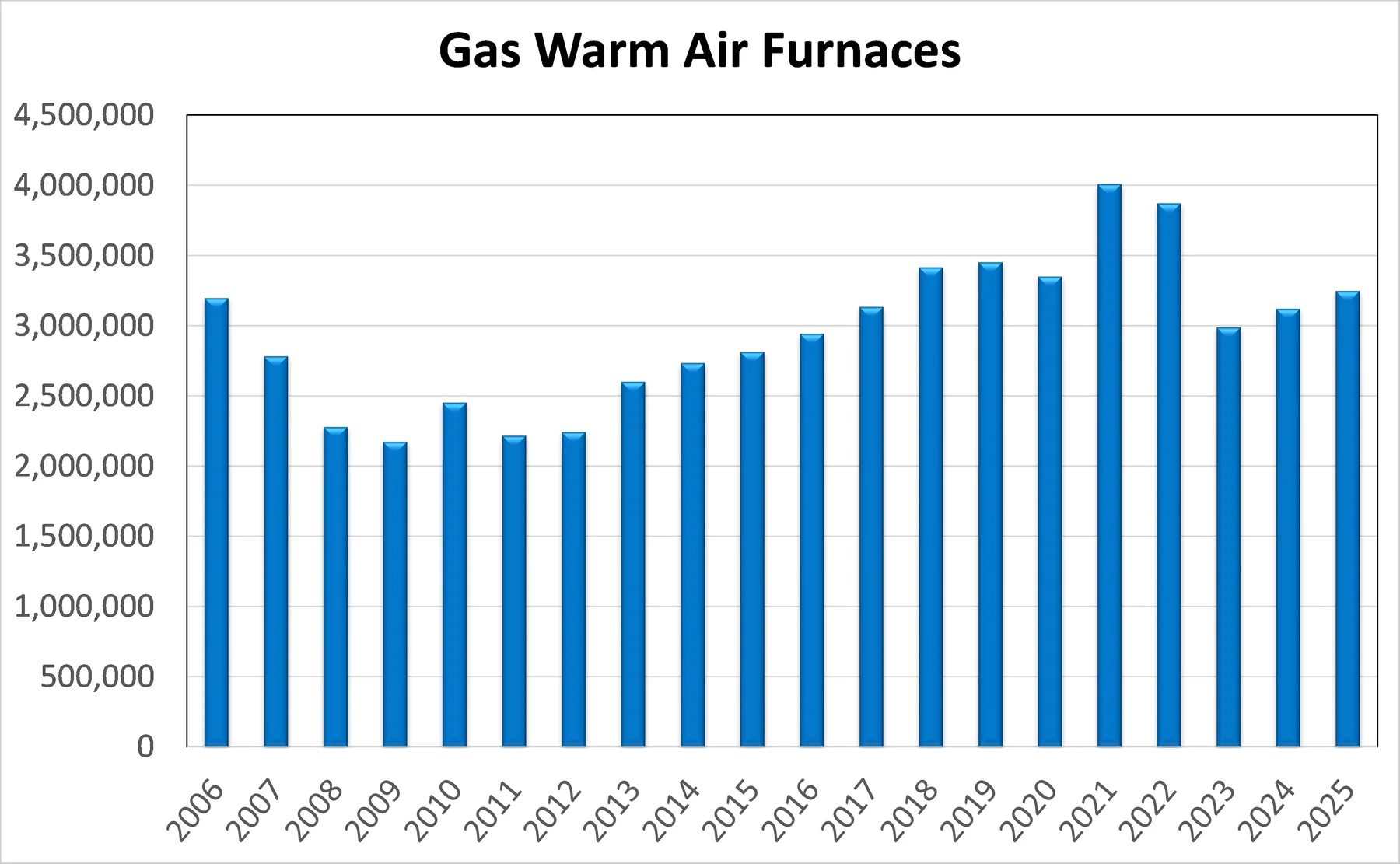
- US makers shipped 4,008,894 gas warm air furnaces in 2021, the high point of the 2006 to 2025 series. (AHRI, Feb 2026)
- Gas furnace shipments through August 2026 were 2,106,454 units, 5.0% below the same months of 2025. (AHRI, Oct 2026)
- A 95% AFUE minimum for new non-weatherized gas furnaces starts on December 18, 2028. (DOE, Dec 2023)
- DOE puts the average gas furnace life at 21.5 years. (DOE, Dec 2023)
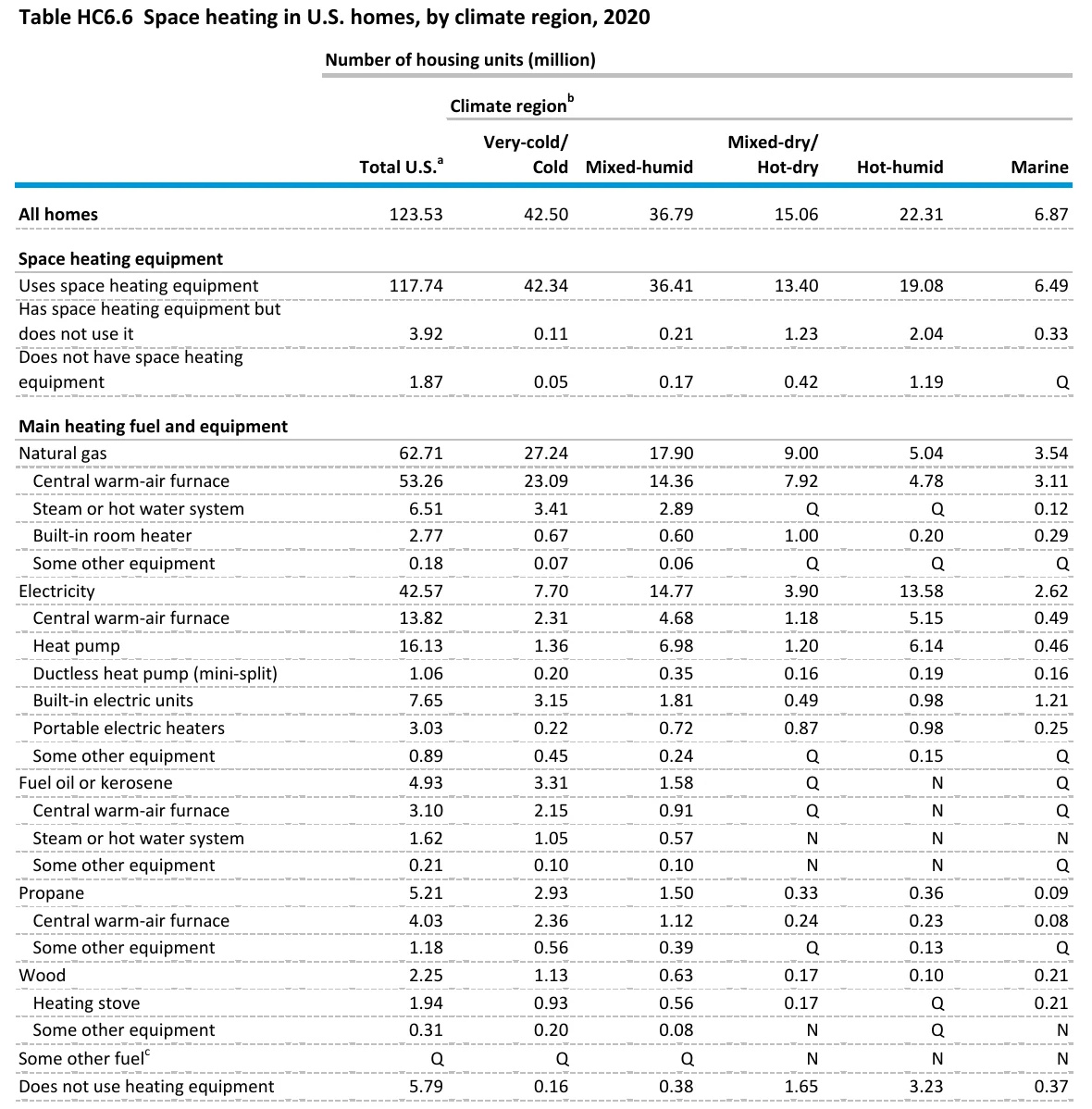
- 23.09 million homes in the very cold and cold climate region heat with a gas central warm-air furnace. (EIA, Mar 2023)
- Forced-air furnaces heated 49% of new single-family homes finished in 2025, against 74% in 1973. (Census Bureau, Jul 2026)
- DOE found that furnaces in existing homes are oversized by 85% on average. (DOE, Dec 2023)
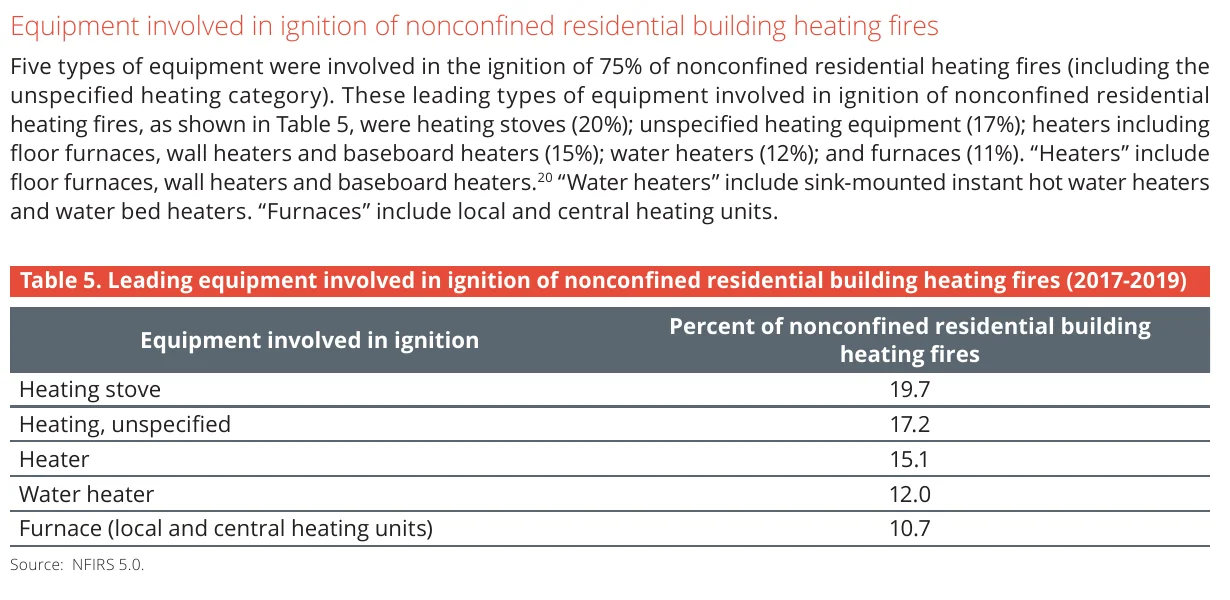
- Furnaces were involved in the ignition of 10.7% of nonconfined residential heating fires. (USFA, Dec 2021)
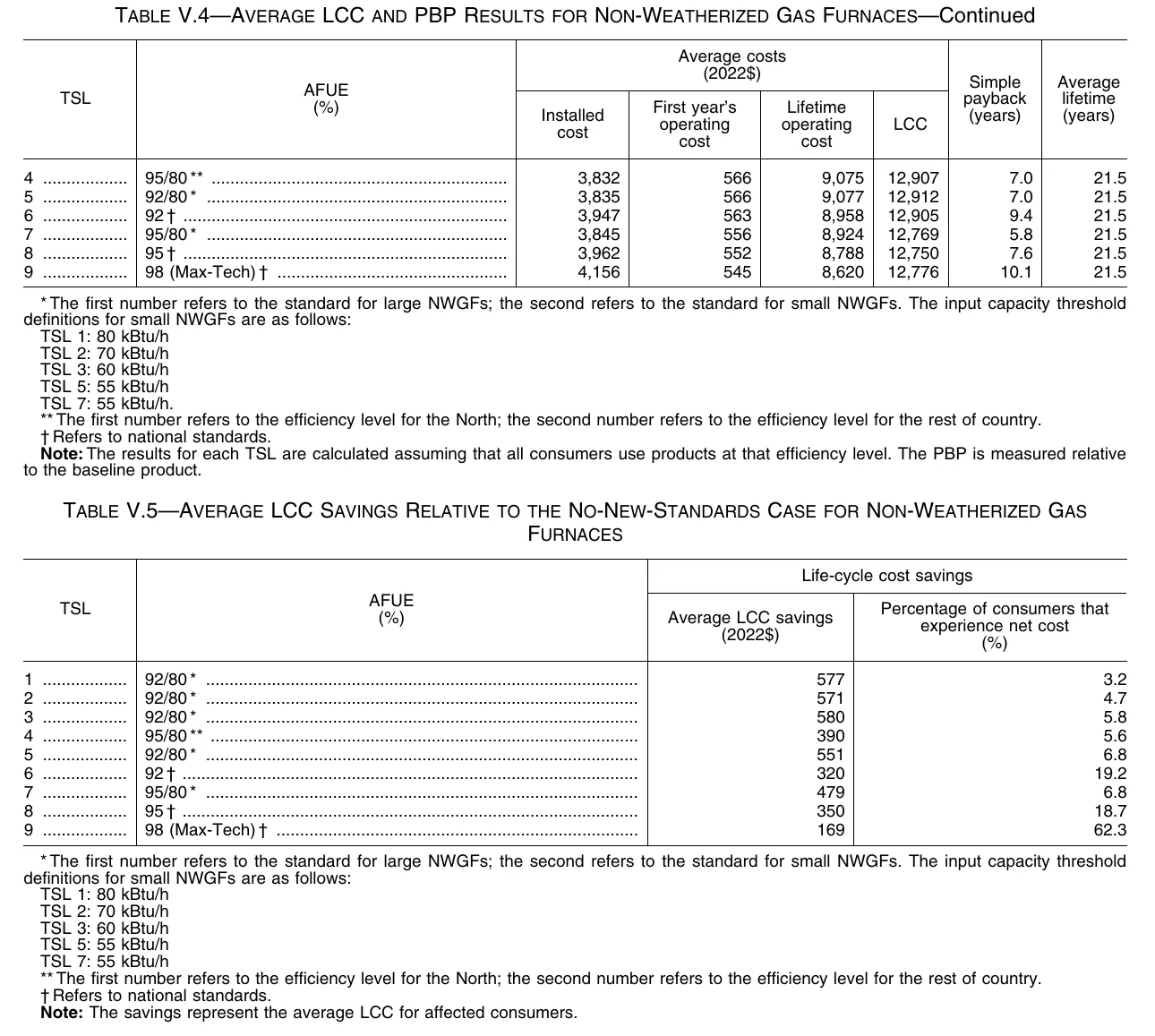
- A 95% AFUE standard saves an affected owner $350 over the life of the furnace, with a 7.6-year payback. (DOE, Dec 2023)
- The federal tax credit of up to $600 for a gas, propane or oil furnace covers installs through December 31, 2025. (IRS, Apr 2026)
- Canada had 6.03 million high-efficiency gas heating systems in 2023, up from 1.06 million in 2000. (NRCan, Oct 2026)
- Goodman recalled about 298,300 drain pans paired with condensing gas furnaces after 23 reports of fire. (CPSC, Nov 2021)
- The HVAC industry generally ships roughly twice as many units in June as in December. (Lennox, Feb 2026)
- ENERGY STAR sets a 97% AFUE floor for gas furnaces in the northern half of the US. (ENERGY STAR, Oct 2026)
Furnace Installed Base: How Many Homes Use One?
Furnaces heat more US homes than any other equipment, and gas is only part of the picture. Electric, propane and oil furnaces heat millions of homes too, and the mix changes sharply from the cold north to the hot south.
Which fuels do furnaces burn?
Electric furnaces are the main heat in 13.82 million US homes, the largest furnace group after gas (EIA, Mar 2023).
- Propane furnaces are the main heat in 4.03 million homes (EIA, Mar 2023).
- Oil furnaces are the main heat in 3.10 million homes (EIA, Mar 2023).
- Single-family detached homes hold 40.51 million of the gas furnace homes (EIA, Mar 2023).
- Apartments in buildings with five or more units use a gas furnace as main heat in 4.61 million cases (EIA, Mar 2023).
- Mobile homes use a gas furnace as main heat in 1.50 million cases (EIA, Mar 2023).
Where in the US are furnaces most common?
Central warm-air furnaces of all fuels are the main heat in 30.04 million homes in the very cold and cold region, more than in any other region (EIA, Mar 2023).
- The mixed-humid region has 14.36 million gas furnace homes (EIA, Mar 2023).
- The mixed-dry and hot-dry region has 7.92 million gas furnace homes (EIA, Mar 2023).
- The marine region has 3.11 million gas furnace homes (EIA, Mar 2023).
- In the hot-humid region 5.15 million homes use an electric furnace, more than the 4.78 million that use gas (EIA, Mar 2023).
- The very cold and cold region holds 2.15 million of the nation’s oil furnace homes (EIA, Mar 2023).
- The same region holds 2.36 million of the propane furnace homes (EIA, Mar 2023).
Do owners or renters use more furnaces?
Owners hold most gas furnaces: 41.61 million owner-occupied homes use one, against 11.65 million rented homes (EIA, Mar 2023).
- Electric furnaces split more evenly, with 7.47 million owner-occupied and 6.35 million rented homes (EIA, Mar 2023).
- Renters in apartments use a central warm-air furnace of any fuel as main heat in 11.03 million homes (EIA, Mar 2023).
Which heating fuel do new homes get?
Gas fueled 42% of the 1,005,000 single-family homes finished in 2025, and electricity fueled 56% (Census Bureau, Jul 2026).
- Forced-air furnaces heated 71% of new single-family homes in 2000 (Census Bureau, Jul 2026).
- The share fell to 56% in 2010 (Census Bureau, Jul 2026).
- It was back at 59% in 2020 (Census Bureau, Jul 2026).
- In the Northeast, 91% of new single-family homes sold in 2025 were heated with gas (Census Bureau, Jul 2026).
How common are high-efficiency gas systems in Canada?
High-efficiency gas systems were 35.7% of Canadian home heating systems in 2023, up from 8.7% in 2000 (NRCan, Oct 2026).
- Medium-efficiency gas systems fell from 1.84 million in 2000 to 1.40 million in 2023 (NRCan, Oct 2026).
- Normal-efficiency gas systems fell from 2.84 million in 2000 to about 1,000 in 2023 (NRCan, Oct 2026).
- Medium-efficiency heating oil systems fell from 768,000 in 2000 to 515,000 in 2023 (NRCan, Oct 2026).
- Electric systems numbered 5.78 million in 2023 (NRCan, Oct 2026).
Furnace Sales: How Many Units Ship Each Year?
Furnace sales follow housing, weather and rules, and they are soft in 2026. Gas furnaces ship in the millions every year, while oil furnaces have shrunk to a niche.
How many furnaces do US makers ship each year?
US makers shipped 3,280,225 gas and oil warm air furnaces in 2025 (AHRI, Feb 2026).
- Gas warm air furnace shipments were 3,120,677 units in 2024 (AHRI, Feb 2026).
- Gas shipments fell from 3,872,368 units in 2022 to 2,989,516 in 2023 (AHRI, Feb 2026).
- The low point of the series was 2,174,528 gas units in 2009 (AHRI, Feb 2026).
- Gas shipments were 3,453,314 units in 2019, before the pandemic (AHRI, Feb 2026).
- Gas shipments were 3,196,715 units in 2006 (AHRI, Feb 2026).
- Oil warm air furnace shipments fell from 92,619 units in 2006 to a low of 22,619 in 2023 (AHRI, Feb 2026).
How are 2026 furnace sales running?
Gas furnace shipments in January 2026 fell 19.8% from a year earlier, to 217,762 units (AHRI, Mar 2026).
- Through March, gas shipments were 715,518 units, down 13.7% (AHRI, May 2026).
- July 2026 shipments rose 2.1% to 265,810 units (AHRI, Sep 2026).
- August 2026 shipments fell 4.3% to 287,710 units (AHRI, Oct 2026).
- Oil warm air furnace shipments through August rose 15.7% to 20,693 units (AHRI, Oct 2026).
When do furnaces ship during the year?
Lennox puts the heating season at roughly November through February (Lennox, Feb 2026).
- Shipments in October 2025 fell 13.0% to 244,324 units (AHRI, Dec 2025).
- Shipments in November 2025 fell 8.4% to 238,810 units (AHRI, Jan 2026).
- December 2025 shipments were flat at 267,065 units (AHRI, Feb 2026).
- February 2026 gas shipments fell 5.6% to 244,774 units (AHRI, Apr 2026).
- March 2026 shipments fell 15.3% to 252,982 units (AHRI, May 2026).
Do replacements or new homes drive furnace sales?
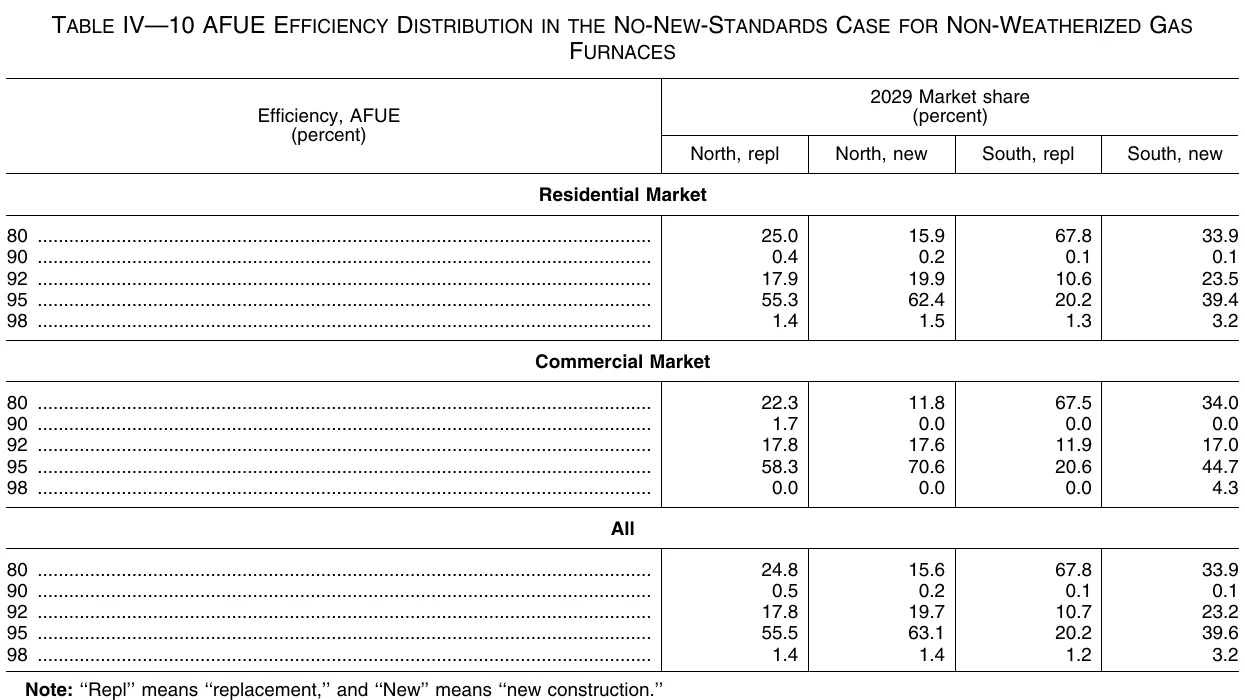
DOE expects 81% of residential non-weatherized gas furnace shipments in 2029 to replace existing equipment, and 19% to go into new construction (DOE, Dec 2023).
- DOE projects 2.930 million residential non-weatherized gas furnace shipments in 2029 (DOE, Dec 2023).
- DOE projects 0.102 million mobile home gas furnace shipments in 2029 (DOE, Dec 2023).
- DOE expects 59% of non-weatherized gas furnace shipments in 2029 to go to the North (DOE, Dec 2023).
- Non-weatherized oil furnace shipments have fallen by more than 70% over 20 years (DOE, Oct 2024).
- Oil furnaces have been less than 1% of the consumer furnace market for 10 years (DOE, Oct 2024).
- Weatherized gas furnaces have been 7% of the consumer furnace market over 20 years (DOE, Oct 2024).
- Non-weatherized units are 74% of gas furnace models on the market (EIA, Mar 2023).
Furnace Efficiency: What Is the Minimum AFUE?
The legal floor is about to rise, and the market is already split. DOE expects northern buyers to choose 95% AFUE more often than any other level.
What is the minimum AFUE for a new furnace?
A non-weatherized gas furnace made before December 18, 2028 must reach 80.0% AFUE (eCFR, Oct 2026).
- Non-weatherized oil-fired furnaces must reach 83.0% (eCFR, Oct 2026).
- Weatherized gas furnaces must reach 81.0% (eCFR, Oct 2026).
- Electric furnaces must reach 78.0% (eCFR, Oct 2026).
- The 80.0% floor for non-weatherized gas furnaces applies to units made on or after November 19, 2015 (eCFR, Oct 2026).
- The 1987 national appliance law set the first floors at 78% AFUE for most furnaces and 75% for mobile home furnaces (DOE, Dec 2023).
- Canada has required 95% AFUE for most gas furnaces made on or after July 3, 2019, after setting 90% in 2009 (DOE, Dec 2023).
How much of the gas furnace market is already condensing?
DOE expects 60.6% of non-weatherized gas furnaces to be sold at condensing levels in 2028, the year before the standard applies (DOE, Dec 2023).
- For mobile home gas furnaces the 2028 condensing share is 33.3% (DOE, Dec 2023).
- DOE expects 55.3% of northern replacement installs in 2029 to be 95% AFUE units (DOE, Dec 2023).
- DOE expects 67.8% of southern replacement installs in 2029 to stay at 80% AFUE (DOE, Dec 2023).
- EIA described the gas furnace market as nearly evenly split between non-condensing and condensing units (EIA, Mar 2023).
- Three gas and propane trade groups told DOE that non-condensing furnaces are about 55% of the gas furnace market, a figure that differs from DOE’s forecast (AGA, APGA and NPGA, Apr 2026).
What do ENERGY STAR levels require?
ENERGY STAR sets 95% AFUE for gas furnaces in the southern half of the US and 87% for oil furnaces (ENERGY STAR, Oct 2026).
- Certified gas and oil furnaces must have air leakage of 2.0% or less (ENERGY STAR, Oct 2026).
- Northern gas models are up to 18% more efficient than baseline models and save $160 a year, according to the program (ENERGY STAR, Oct 2026).
- Southern gas models are up to 16% more efficient and save an average of $60 a year (ENERGY STAR, Oct 2026).
- Certified oil models are up to 4% more efficient and save about $90 a year (ENERGY STAR, Oct 2026).
- The most efficient gas furnace on the market reached 99.0% AFUE, and non-condensing models top out at 82% (EIA, Mar 2023).
- Natural Resources Canada models its gas furnace stock at 62%, 80% and 90% efficiency for normal, medium and high-efficiency units (NRCan, Oct 2026).
Furnace Lifespan: How Long Does One Last?
A furnace outlasts most things around it, and the range is wide. Sources disagree by years, and the climate and the home change the answer.
How long does a furnace last?
In the North, DOE’s average gas furnace life is 22.5 years, and in the rest of the country it is 20.2 years (DOE, Dec 2023).
- DOE’s literature review found lifetimes from 16 years to 23.6 years (DOE, Dec 2023).
- DOE tested median lifetimes of 16 years for a low case and 27 years for a high case (DOE, Dec 2023).
- DOE found no data showing that condensing furnaces last a shorter time than non-condensing ones (DOE, Dec 2023).
- DOE uses the same 20.2 to 22.5 year range for oil and weatherized gas furnaces (DOE, Oct 2024).
- EIA lists a typical life range of 17 to 26 years for northern gas furnaces (EIA, Mar 2023).
- EIA lists 16 to 25 years for gas furnaces in the rest of the country (EIA, Mar 2023).
- EIA lists a typical life range of 20 to 33 years for oil furnaces (EIA, Mar 2023).
How many homes run old heating equipment?
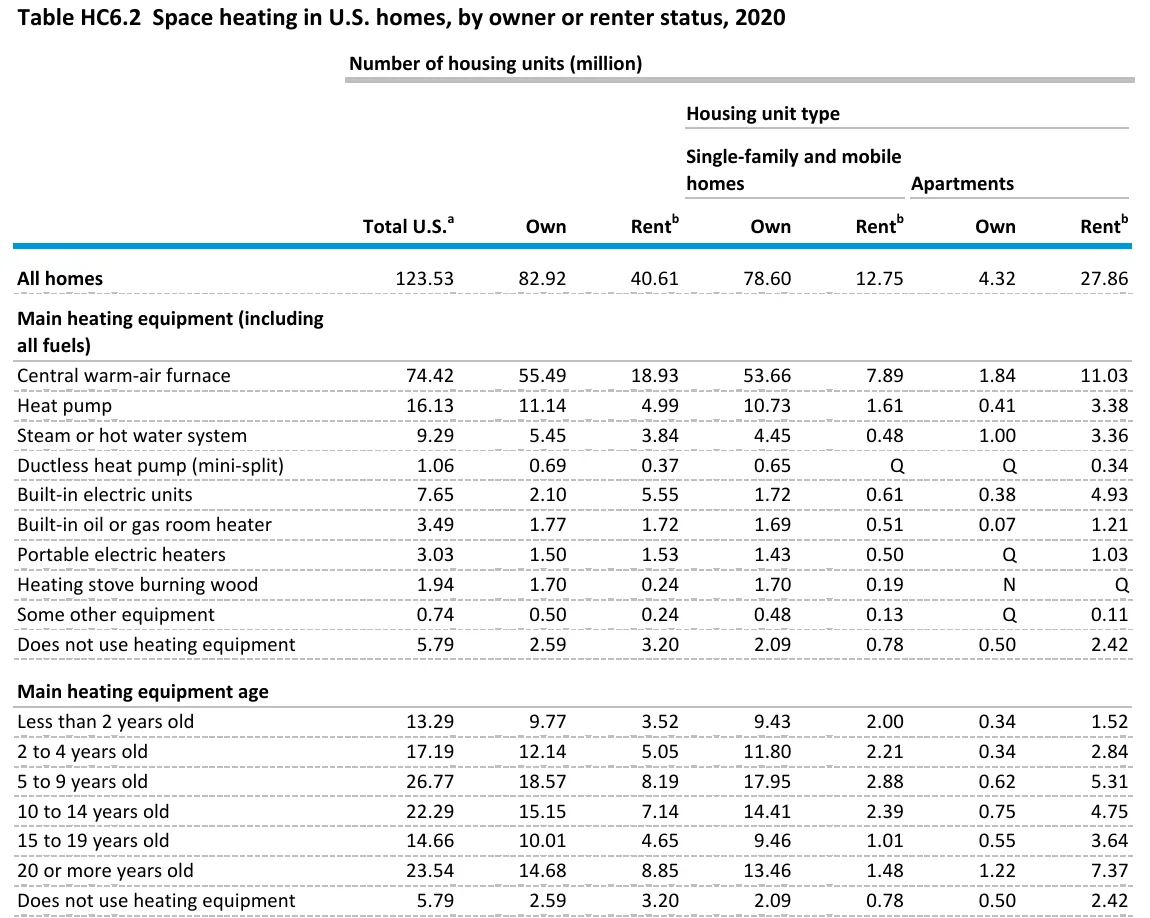
Owners have 14.68 million homes with main heating equipment that is 20 or more years old, and renters have 8.85 million (EIA, Mar 2023).
- The very cold and cold region has 10.32 million homes with equipment that old (EIA, Mar 2023).
- The mixed-humid region has 6.84 million (EIA, Mar 2023).
- The hot-humid region has 1.83 million (EIA, Mar 2023).
- Renters in apartments account for 7.37 million of the homes with equipment that old (EIA, Mar 2023).
- Homes built before 1950 account for 5.16 million of them (EIA, Mar 2023).
When an old furnace fails, the replacement is the time to size the new one from the house load, not from the old nameplate.
What does it take to keep a furnace running?
DOE’s model has 1.8% of owners repairing a furnace instead of replacing it when the 95% standard applies (DOE, Dec 2023).
- EIA lists annual maintenance at $120 for an 80% AFUE gas furnace (EIA, Mar 2023).
- EIA lists annual maintenance at $130 for a gas furnace at 90% AFUE or higher (EIA, Mar 2023).
- EIA listed maintenance at $60 a year for the installed base of northern gas furnaces (EIA, Mar 2023).
Furnace Cost and Savings: What Does a New One Run?
The box is the cheap part. Most of the bill is installation, venting and labor, so the jump from one AFUE level to the next is small next to the whole job.
What does a new gas furnace cost installed?
EIA puts the installed cost of an 80% AFUE gas furnace at $3,690 and a 95% unit at $4,150, in 2022 dollars (EIA, Mar 2023).
- A 90% AFUE unit costs $4,130 installed (EIA, Mar 2023).
- A 99% AFUE unit costs $4,320 installed (EIA, Mar 2023).
- The retail price of the equipment alone is $1,080 for an 80% AFUE unit (EIA, Mar 2023).
- DOE puts the average installed cost of a 95% AFUE non-weatherized gas furnace at $3,962 in 2022 dollars (DOE, Dec 2023).
- DOE puts a 95% mobile home gas furnace at $2,583 installed (DOE, Dec 2023).
- Armstrong and Air Ease 96% furnaces in a 2023 recall were sold through dealers for between $1,800 and $3,400 (CPSC, Jun 2023).
What does a furnace cost to run?
DOE puts the first-year operating cost of a 95% AFUE gas furnace at $552, and $8,788 over its life, in 2022 dollars (DOE, Dec 2023).
- A 95% mobile home gas furnace costs $500 to run in the first year (DOE, Dec 2023).
- An 80% AFUE gas furnace uses 386 kilowatt-hours of electricity a year for its fan, inducer and ignitor (EIA, Mar 2023).
- A 90% AFUE unit uses 636 kilowatt-hours a year (EIA, Mar 2023).
What does a higher AFUE save?
DOE counts 18.7% of affected non-weatherized gas furnace buyers as paying a net cost under a 95% standard (DOE, Dec 2023).
- Mobile home gas furnace buyers save $616 on average, with a 3.2-year payback (DOE, Dec 2023).
- Low-income households have a 2.5-year payback on a 95% furnace (DOE, Dec 2023).
- 15.9% of low-income households and 15.5% of senior-only households buying a non-weatherized gas furnace pay a net cost (DOE, Dec 2023).
- DOE estimates 4.77 quadrillion Btu of lifetime energy savings for units bought from 2029 to 2058 (DOE, Dec 2023).
- That is a saving of 3.2% against what these furnaces would otherwise use (DOE, Dec 2023).
- DOE counts $24.8 billion in consumer operating savings against $8.5 billion in added product costs at a 3% discount rate (DOE, Dec 2023).
- DOE counts 332 million metric tons of avoided carbon dioxide over the same period (DOE, Dec 2023).
What did the federal tax credit cover?
The credit equaled 30% of qualified costs (IRS, Apr 2026).
- The maximum annual credit for most home improvements was $1,200 (IRS, Apr 2026).
- Installation labor counted toward the cost of a qualifying gas, propane or oil furnace (IRS, Apr 2026).
- In 2025 each item also had to come from a qualified manufacturer and carry its identification number on the tax return (IRS, Apr 2026).
Furnace Rules: What Happens in 2028?
The 2028 rule is law, yet the fight is not over. A court upheld it, and gas and propane groups are asking for more time.
What does the 2028 standard require?
DOE published the final rule on December 18, 2023, and it took effect on February 16, 2024 (DOE, Dec 2023).
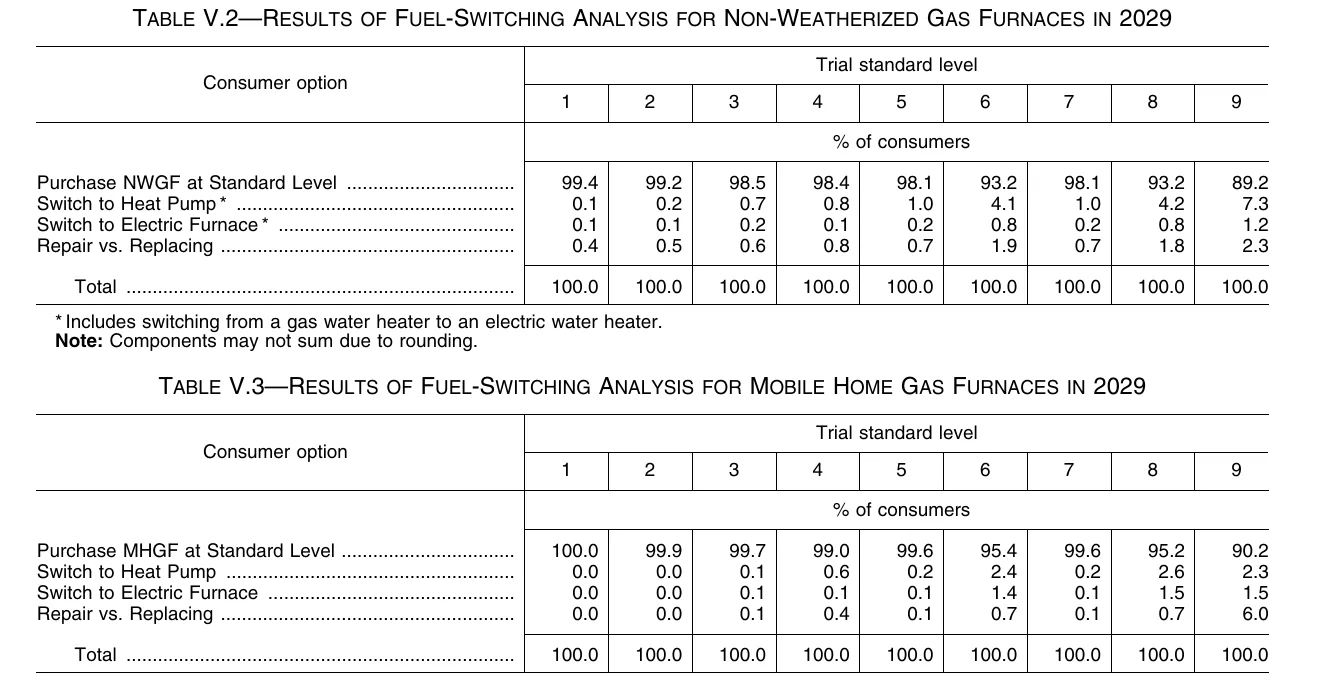
- DOE models 93.2% of non-weatherized gas furnace buyers purchasing a unit at the 95% level (DOE, Dec 2023).
- It models 4.2% switching to a heat pump and 0.8% switching to an electric furnace (DOE, Dec 2023).
- For mobile home gas furnaces, 2.6% switch to a heat pump (DOE, Dec 2023).
- DOE estimates $162.0 million in industry conversion costs (DOE, Dec 2023).
- DOE puts industry value without the rule at $1,371.8 million and expects it to fall by 2.5% to 26.8% (DOE, Dec 2023).
What did DOE decide for other furnace types?
In October 2024 DOE decided that standards for electric, oil-fired and weatherized gas furnaces do not need to change, effective November 18, 2024 (DOE, Oct 2024).
What is the legal status of the rule?
The D.C. Circuit denied the petitions against the rule in a decision dated November 4, 2025 (D.C. Circuit, Nov 2025).
- Gas and propane groups and a furnace maker asked the Supreme Court to review that decision on January 20, 2026 (AGA, APGA and NPGA, Apr 2026).
- On February 19, 2026 they asked DOE to move the compliance date to January 1, 2030 at the earliest (AGA, APGA and NPGA, Apr 2026).
- DOE asked for public comment on that petition in a notice dated April 27, 2026 (DOE, Apr 2026).
- The notice still lists December 18, 2028 as the current compliance date (DOE, Apr 2026).
Furnace Safety: Fires, Recalls and Faults
Furnaces are not the leading source of heating fires. The recall record shows specific parts failing, such as a mis-assembled component or a drain pan that melts.
How often do furnaces start fires?
From 2017 to 2019, fire departments handled an estimated 34,200 residential heating fires a year, with 165 deaths and 600 injuries (USFA, Dec 2021).
- Confined fires were 76.59% of residential heating fires (USFA, Dec 2021).
- Chimney and flue fires were 49.43% of all residential heating fires (USFA, Dec 2021).
- Fuel burner and boiler malfunctions, confined to the burner, were 27.16% (USFA, Dec 2021).
- Confined fuel burner and boiler malfunctions were 45% of the heating fires in June, July and August (USFA, Dec 2021).
- Heating fires peaked in January at 20% (USFA, Dec 2021).
- The heat source was too close to combustibles in 27% of nonconfined heating fires (USFA, Dec 2021).
- Smoke alarms were present in 56% of nonconfined heating fires in occupied homes (USFA, Dec 2021).
Which furnace recalls stand out?
Allied Air recalled about 9,255 Armstrong Air and Air Ease gas furnaces in June 2023 after a part was assembled wrongly and could raise carbon monoxide (CPSC, Jun 2023). Readers who want the poisoning side can see carbon monoxide poisoning statistics.
- The recalled units were sold between September 2022 and March 2023 (CPSC, Jun 2023).
- CPSC listed no reported incidents for that recall (CPSC, Jun 2023).
- Goodman’s drain pan recall covered pans installed or repaired between January 2019 and November 2021 (CPSC, Nov 2021).
- About 44,000 more pans were recalled in Canada (CPSC, Nov 2021).
- The pans sold for between $200 and $1,200 per unit (CPSC, Nov 2021).
Furnace Sizing: How Oversized Are Furnaces?
Oversizing is the quiet cost in furnace work, and DOE calls it common industry practice. A load calculation is the way to find out how big a furnace needs to be.
How oversized are furnaces in homes?
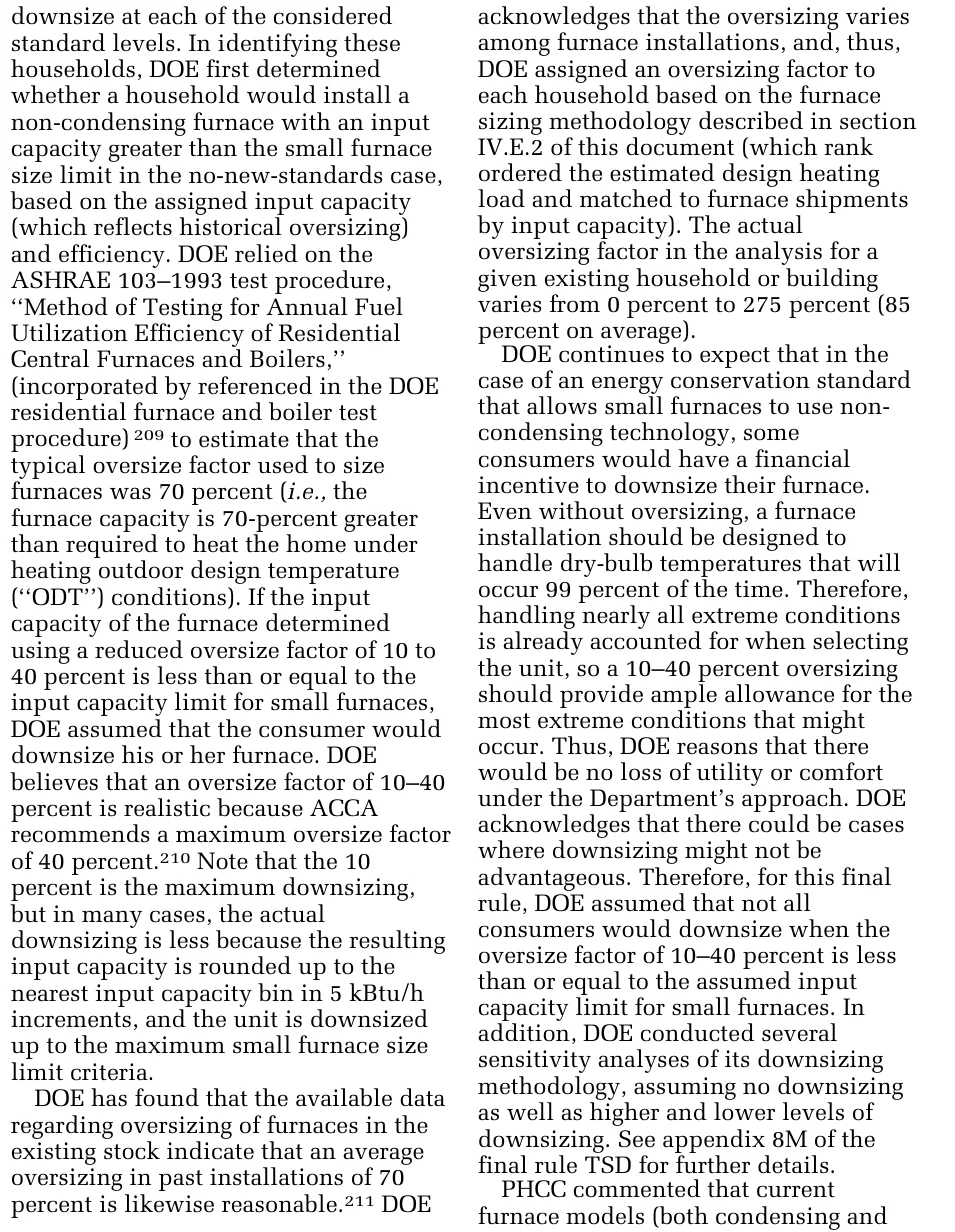
DOE says the typical oversize factor used to size furnaces was 70%, so the furnace is 70% larger than the load at design temperature (DOE, Dec 2023).
- The oversizing factor in DOE’s sample ran from 0% to 275% (DOE, Dec 2023).
- DOE says ACCA recommends a maximum oversize factor of 40% (DOE, Dec 2023).
- DOE notes that an installation designed for dry-bulb temperatures that occur 99% of the time already covers nearly all extreme conditions (DOE, Dec 2023).
The free furnace sizing calculator turns a heating load into the input size to look for.
How big are the furnaces that ship?
Furnaces rated 80 kBtu/h or less are 54.6% of non-weatherized gas furnace shipments in DOE’s 2028 forecast (DOE, Dec 2023).
- Furnaces of 70 kBtu/h or less are 30.5% of shipments (DOE, Dec 2023).
- Furnaces of 60 kBtu/h or less are 18.9% (DOE, Dec 2023).
- EIA uses 80 kBtu/h as the typical input capacity for a gas furnace (EIA, Mar 2023).
- EIA uses 105 kBtu/h as the typical input capacity for an oil furnace (EIA, Mar 2023).
What home sizes do furnaces serve?
The average US home had 1,818 square feet in 2020, and 1,614 of them were heated (EIA, Mar 2023).
- Homes under 1,000 square feet use a central warm-air furnace as main heat in 12.89 million cases (EIA, Mar 2023).
- Homes of 1,000 to 1,499 square feet use one in 16.07 million cases (EIA, Mar 2023).
- Homes of 3,000 square feet or more use one in 12.58 million cases (EIA, Mar 2023).
- The median new single-family home finished in 2025 had 2,142 square feet (Census Bureau, Jul 2026).
For related numbers on equipment age and replacement cycles, see residential HVAC replacement statistics. For the fuel competing with furnaces, see heat pump statistics.
Methodology and Sources
Every number comes from the organization that produced it: federal agencies, a trade body that collects shipments from its members, a federal court, a public company filing and the Canadian government. No statistics roundup is cited. Each link was opened, and each number was read in the saved source text before it was written here. Where a source shows no release date, the citation date is the month the page was read. Where sources disagree, both are shown and named. The page is refreshed monthly when AHRI posts new shipment data.
Glossary
- AFUE: Annual Fuel Utilization Efficiency, the share of fuel energy that becomes heat in the home over a season.
- ACCA: Air Conditioning Contractors of America, a trade body for HVAC contractors.
- AHRI: Air-Conditioning, Heating, and Refrigeration Institute, a trade body that publishes monthly shipment data.
- Condensing furnace: A furnace that cools its exhaust enough to turn water vapor into liquid and capture more heat.
- CPSC: US Consumer Product Safety Commission.
- DOE: US Department of Energy.
- EIA: US Energy Information Administration.
- kBtu/h: Thousand British thermal units per hour, a measure of furnace input capacity.
- Mobile home gas furnace: A gas furnace made for installation in a manufactured home.
- Non-weatherized gas furnace: An indoor gas furnace, as opposed to an outdoor (weatherized) unit.
- NRCan: Natural Resources Canada.
- USFA: US Fire Administration.
Sources
- AHRI, Furnaces Historical Data, Feb 2026
- AHRI, October 2025 shipment data, Dec 2025
- AHRI, November 2025 shipment data, Jan 2026
- AHRI, December 2025 shipment data, Feb 2026
- AHRI, January 2026 shipment data, Mar 2026
- AHRI, February 2026 shipment data, Apr 2026
- AHRI, March 2026 shipment data, May 2026
- AHRI, July 2026 shipment data, Sep 2026
- AHRI, August 2026 shipment data, Oct 2026
- EIA, 2020 RECS Table HC6.1, Mar 2023
- EIA, 2020 RECS Table HC6.2, Mar 2023
- EIA, 2020 RECS Table HC6.3, Mar 2023
- EIA, 2020 RECS Table HC6.6, Mar 2023
- EIA, 2020 RECS Table HC6.9, Mar 2023
- EIA, 2020 RECS Table HC10.9, Mar 2023
- EIA, Updated Buildings Sector Appliance and Equipment Costs and Efficiencies, Mar 2023
- DOE, Energy Conservation Standards for Consumer Furnaces, final rule, Dec 2023
- DOE, Standards for Oil, Electric, and Weatherized Gas Consumer Furnaces, final determination, Oct 2024
- DOE, Notification of Petition for Rulemaking, Apr 2026
- eCFR, 10 CFR 430.32, Oct 2026
- U.S. Court of Appeals for the D.C. Circuit, American Gas Association v. DOE, Nov 2025
- ENERGY STAR, Furnaces, Oct 2026
- ENERGY STAR, Furnaces Key Product Criteria, Oct 2026
- IRS, Energy Efficient Home Improvement Credit, Apr 2026
- U.S. Census Bureau, Characteristics of New Housing, Type of heating system, Jul 2026
- U.S. Census Bureau, Highlights of 2025 Characteristics of New Housing, Jul 2026
- NRCan, Residential Sector Canada Table 27: Heating System Stock by Building Type and Heating System Type, Oct 2026
- NRCan, Residential Sector Canada Table 32: Heating System Stock Efficiencies, Oct 2026
- USFA, Heating Fires in Residential Buildings (2017-2019), Dec 2021
- CPSC, Allied Air Enterprises recall of Armstrong Air and Air Ease gas furnaces, Jun 2023
- CPSC, Goodman evaporator coil drain pan recall, Nov 2021
- Lennox International, Form 10-K for 2025, Feb 2026