ENERGY STAR statistics tell two stories at once. One is a voluntary label that sits on appliances, furnaces, heat pumps, new homes and office buildings. The other is a federal program that changed hands in 2026, when the Department of Energy took over the lead from the Environmental Protection Agency.
This page collects the numbers from the groups that produced them: EPA and DOE, the Energy Information Administration, the Government Accountability Office, the IRS, the Consortium for Energy Efficiency, the European Commission and peer-reviewed economists. It also counts the certified products itself, using the open data that EPA publishes for every category. Where a figure is a model estimate and not a meter reading, the text says so.
If you size and install HVAC equipment, start with the heating and cooling section. The label tells you the rated efficiency of a unit. It does not tell you whether the unit fits the house.
Key Takeaways
- ENERGY STAR and its partners have helped American families and businesses avoid more than $500 billion in energy costs since 1992 (ENERGY STAR, Oct 2026).
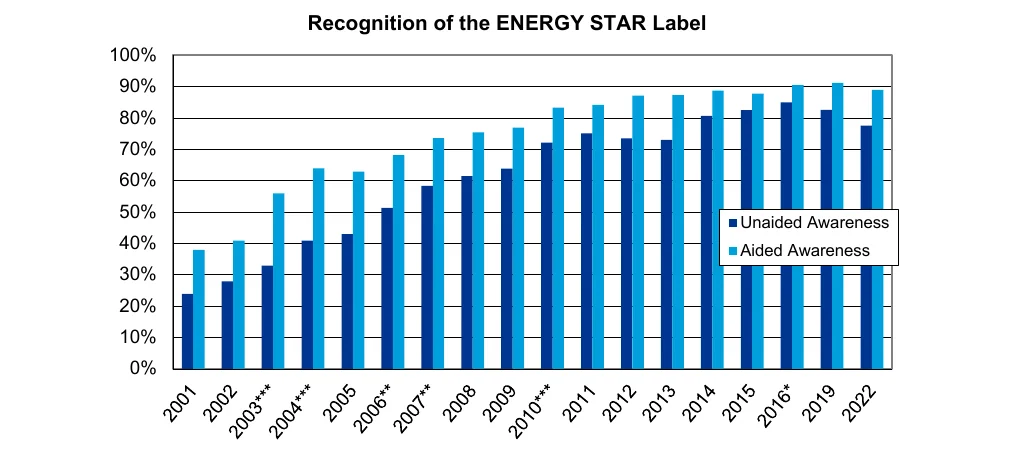
- 89% of US households recognize the ENERGY STAR label when they are shown it (EPA, Nov 2023).
- The ENERGY STAR Model Index lists 1,796,876 certified entries in 47 product categories (ENERGY STAR open data, Oct 2026).
- 80% of the 285,054 listed ENERGY STAR heat pump systems use the refrigerant R-454B (ENERGY STAR open data, Oct 2026).
- All 577 listed ENERGY STAR room air conditioners use R-32 and a variable speed compressor (ENERGY STAR open data, Oct 2026).
- 96% of the dishwashers shipped in 2022 were ENERGY STAR certified (ENERGY STAR, Sep 2023).
- GAO got 15 of 20 made-up products approved for the ENERGY STAR label in a 2010 covert test (GAO, Mar 2010).
- Federal efficiency standards cut utility bills for households and businesses by $105 billion in 2024 alone (DOE, Mar 2025).
- DOE became the lead federal agency for ENERGY STAR under an agreement that took effect on March 3, 2026 (EPA and DOE, Mar 2026).
- 45.47 million US homes run a second refrigerator (EIA, Mar 2026).
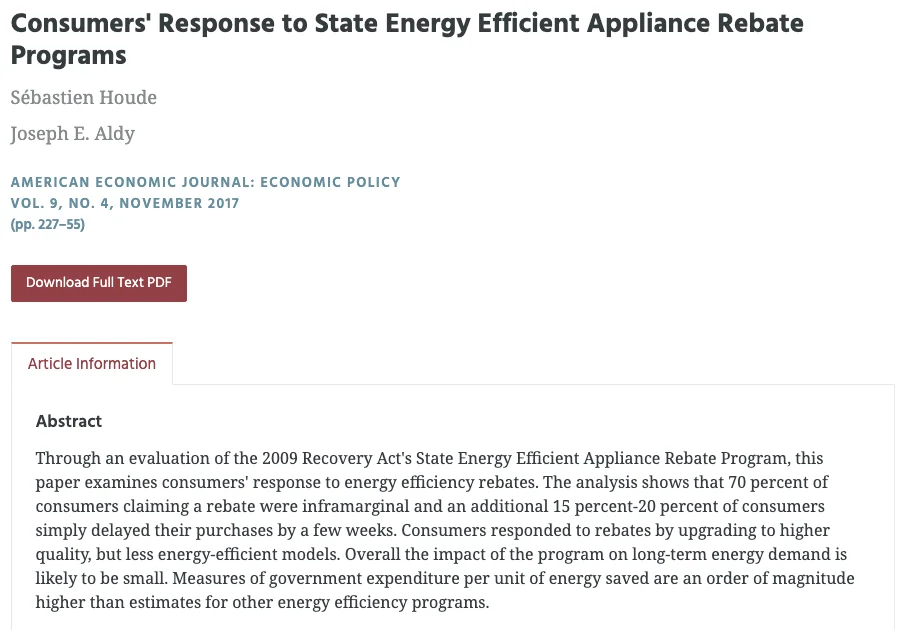
- 70% of consumers who claimed a state appliance rebate in 2009 would have bought the product anyway (AEA, Nov 2017).
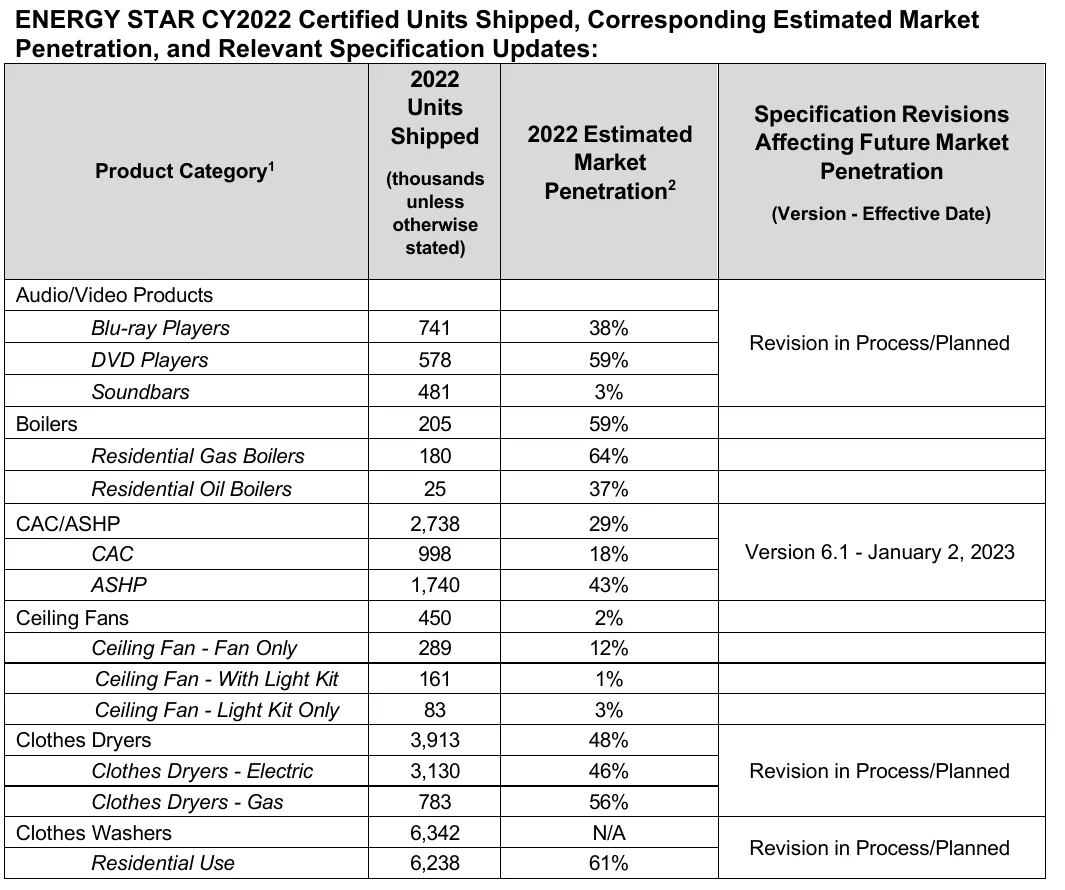
- 43% of air source heat pumps shipped in 2022 were ENERGY STAR certified, against 18% of central air conditioners (ENERGY STAR, Sep 2023).
- The EU energy label is recognised by 93% of consumers (European Commission, May 2024).
How Much Has the ENERGY STAR Program Saved Since 1992?
The program’s headline totals are large, and they are model estimates. Read them as the program’s own accounting, then compare them with the mandatory standards that sit under the label. For how much of a home’s energy goes to heating and cooling in the first place, see HVAC energy consumption statistics.
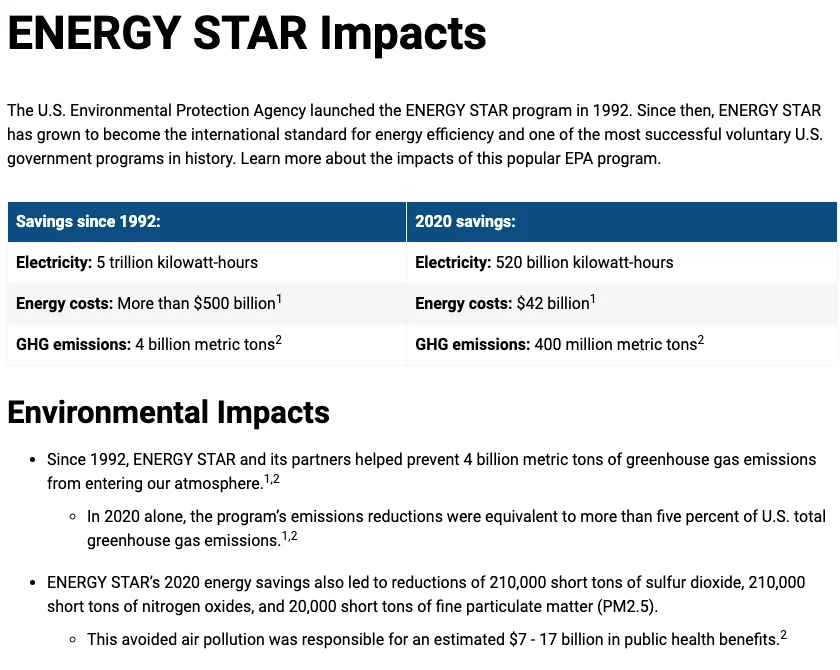
How much energy and money has the program saved?
Since 1992 the program and its partners have saved 5 trillion kilowatt-hours of electricity (ENERGY STAR, Oct 2026).
- In 2020 alone the savings were 520 billion kilowatt-hours of electricity and $42 billion in energy costs (ENERGY STAR, Oct 2026).
- The program and its partners helped prevent 4 billion metric tons of greenhouse gas emissions since 1992, and the 2020 reductions alone equaled more than five percent of total US emissions (ENERGY STAR, Oct 2026).
- The 2020 savings cut sulfur dioxide by 210,000 short tons and led to an estimated $7 to $17 billion in public health benefits (ENERGY STAR, Oct 2026).
- Every dollar EPA spent on the program drew $230 of investment from businesses and households and produced nearly $350 in energy cost savings (ENERGY STAR, Oct 2026).
- A typical household can save about $450 a year on energy bills by choosing ENERGY STAR (ENERGY STAR, Oct 2026).
- The cost savings are the present value of bill savings minus the extra money spent on efficient equipment (ENERGY STAR, Oct 2026).
- EPA and DOE say the markets that depend on the label save the equivalent of 13 percent of US electricity use each year (EPA and DOE, Aug 2026).
How does a voluntary label compare with mandatory standards?
DOE’s mandatory standards cover more than 70 products and about 90% of home energy use (DOE, Mar 2025).
- A typical household saved about $576 on energy and water bills in 2024 because of those standards (DOE, Mar 2025).
- Standards adopted through January 2025 are expected to save over 160 quadrillion Btus through 2035 (DOE, Mar 2025).
- Standards implemented from 2021 to 2024 will cut utility bills by over $1 trillion over 30 years (DOE, Mar 2025).
- DOE says those same standards save the average family at least $100 a year (DOE, Mar 2025).
- They will cut greenhouse gas emissions by approximately 2 billion metric tons (DOE, Mar 2025).
How Many ENERGY STAR Certified Products Are There?
The honest answer depends on how you count. EPA quotes tens of thousands of models, and the open data lists well over a million entries, because HVAC systems are listed as pairings.
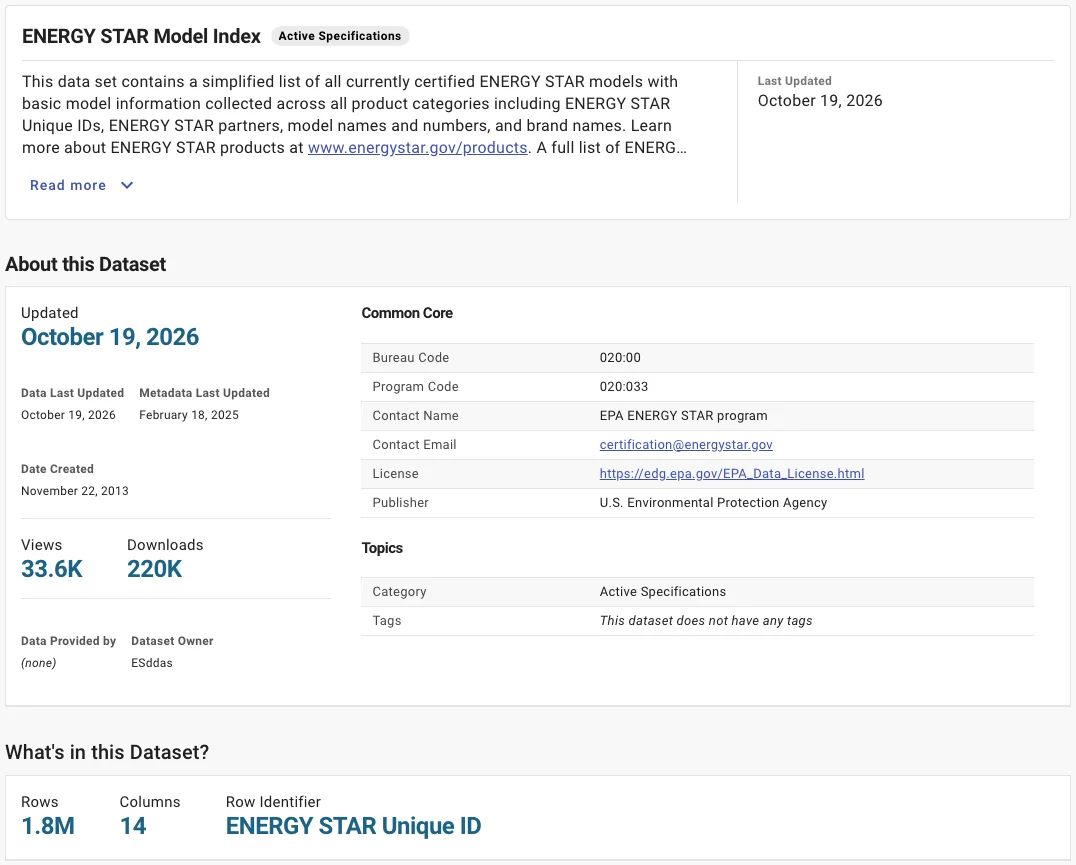
How many certified models does EPA count?
EPA says more than 80,000 product models have earned the ENERGY STAR, across approximately 65 residential and commercial product categories (ENERGY STAR, Oct 2026).
- The transition plan counts over 15,000 active partners and more than 10 partnership types (EPA and DOE, Aug 2026).
Why does the open data list so many more entries?
Central air conditioners and air source heat pumps account for 1,751,701 of the 1,796,876 Model Index entries (ENERGY STAR open data, Oct 2026).
Each row in the heat pump file pairs an outdoor unit with an indoor unit.
- The 285,054 heat pump rows cover only 8,583 distinct outdoor model numbers, and one number appears in 8,720 rows (ENERGY STAR open data, Oct 2026).
- This pairing is the likely reason the open data and the 80,000 model count do not conflict.
How big is the paperwork behind the label?
EPA’s 2025 paperwork filing counts 3,877 partners and recognized bodies that report to the product labeling program (EPA, Nov 2025).
- EPA estimates the reporting takes 44,110 hours and costs about $3.0 million a year (EPA, Nov 2025).
- The last approval counted 2,732 respondents (EPA, Aug 2025).
- EPA says the main reason for the rise is higher program participation (EPA, Nov 2025).
How Much Energy Do ENERGY STAR Appliances Save?
The label’s edge over the legal minimum swings by product: small for refrigerators, large for room air conditioners. The federal floor does much of the work either way, so the useful question is how far above the floor a model sits.
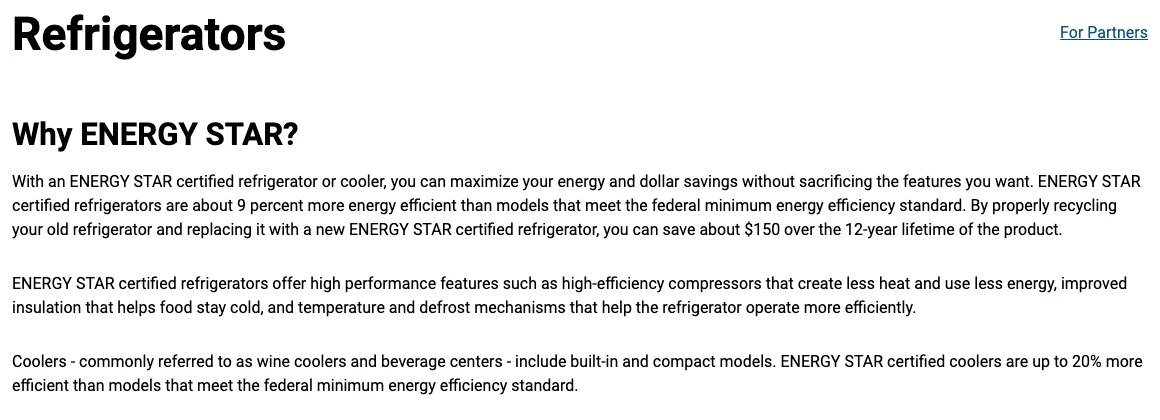
How much better is a certified refrigerator or freezer?
ENERGY STAR certified refrigerators are about 9 percent more energy efficient than models that meet the federal minimum (ENERGY STAR, Oct 2026).
- Recycling the old unit and buying a certified refrigerator saves about $150 over the 12-year life of the product (ENERGY STAR, Oct 2026).
- The average listed refrigerator model is 13% below the federal standard, and 986 of the 4,888 listed models meet the Most Efficient criteria (ENERGY STAR open data, Oct 2026).
How much do certified washers, dryers and dishwashers save?
Certified clothes washers use about 20% less energy and about 30% less water than regular washers (ENERGY STAR, Oct 2026).
- If every clothes dryer sold were certified, Americans could save more than $1.5 billion a year, and heat pump dryers use around 70% less energy than a conventional dryer (ENERGY STAR, Oct 2026).
- The average listed dishwasher model uses 24% less energy than the federal standard, and 102 of the 757 models meet the Most Efficient criteria (ENERGY STAR open data, Oct 2026).
How do cooling and fans compare?
The average listed room air conditioner model uses 41% less energy than the federal standard (ENERGY STAR open data, Oct 2026).
- Certified ceiling fans are up to 44% more efficient than conventional fans (ENERGY STAR, Oct 2026).
Do measured savings match the label?
GAO notes that certified products are generally 10 to 25 percent more efficient than the federal minimum (GAO, Mar 2010).
- In Mexico, a replacement program helped 1.9 million households swap old refrigerators and air conditioners for efficient models (AEA, Nov 2014).
- Billing records showed refrigerator replacement cut electricity use by 8 percent, about one quarter of what planners predicted (AEA, Nov 2014).
- The same study found that air conditioner replacement increased electricity use, and the program cut carbon dioxide at a cost of over $500 per ton (AEA, Nov 2014).
Which ENERGY STAR Heating and Cooling Equipment Is Certified?
Certification gives you the rated efficiency of the equipment. Sizing and installation decide how much of that rating a house gets. The counts below come from EPA’s open files, pulled on October 20, 2026. For sales and cold climate performance, see heat pump statistics.
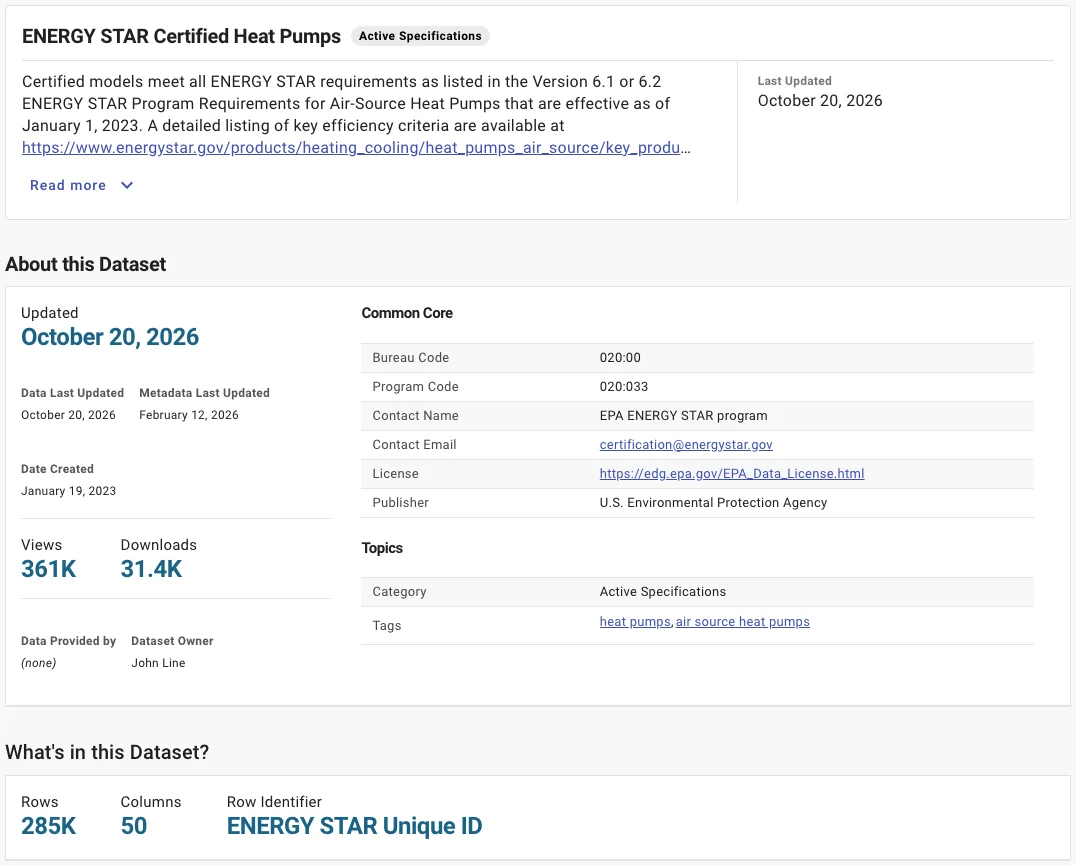
What do certified heat pump systems look like?
The heat pump file lists 285,054 certified systems from 148 partners, and 148,035 of them (52%) carry the cold climate designation (ENERGY STAR open data, Oct 2026).
- 266,360 of the listed systems are split systems, 17,839 are mini or multi splits and 855 are single package units (ENERGY STAR open data, Oct 2026).
- 161,266 listed systems (57%) use a continuously variable compressor, 73,359 use two stages and 50,429 use a single stage (ENERGY STAR open data, Oct 2026).
- Rated efficiency runs from 15.20 SEER2 at the floor to 35.10 SEER2 at the top (ENERGY STAR open data, Oct 2026).
- 50,325 listed systems (18%) still use R-410A, and 5,630 (2%) use R-32 (ENERGY STAR open data, Oct 2026).
What about furnaces, boilers and water heaters?
The furnace file lists 3,733 certified models from 75 brands, and 945 of them (25%) are rated at 97 AFUE or higher (ENERGY STAR open data, Oct 2026).
- 2,394 listed furnaces (64%) are certified for the US South only (ENERGY STAR open data, Oct 2026).
- 450 of the 659 certified boilers (68%) are rated at 95 AFUE or higher, and 150 of them burn oil (ENERGY STAR open data, Oct 2026).
- 717 of the 1,374 certified water heaters (52%) are heat pump models (ENERGY STAR open data, Oct 2026).
- The light commercial HVAC file lists 12,668 certified entries from 34 brands, and 98% of them use R-454B (ENERGY STAR open data, Oct 2026).
Does certified equipment still need the right size and install?
ENERGY STAR says improper installation can reduce system efficiency by up to 30 percent (ENERGY STAR, Oct 2026).
- EPA warns that oversized equipment may cycle too frequently, which means less comfort and a shorter lifespan (ENERGY STAR, Oct 2026).
EPA tells homeowners to ask contractors to size equipment from the actual traits of the house and not from a rule of thumb. A load calculation is the tool for that, and the free AC tonnage calculator is a quick way to check a quote against the house.
How Many Households Know and Buy ENERGY STAR Products?
Recognition is close to its ceiling. The number that moves is how much the label sways a purchase, and it has been falling.
How many households recognize the label?
78% of households reported seeing or hearing about ENERGY STAR before they were shown the label (EPA, Nov 2023).
- 84% of households had at least a general understanding of what the label means, and 68% had a high understanding (EPA, Nov 2023).
- The survey behind these numbers was the 19th national survey, fielded in the fall of 2022 in the 57 largest media markets (CEE, Oct 2026).
How many households buy certified products and trust the label?
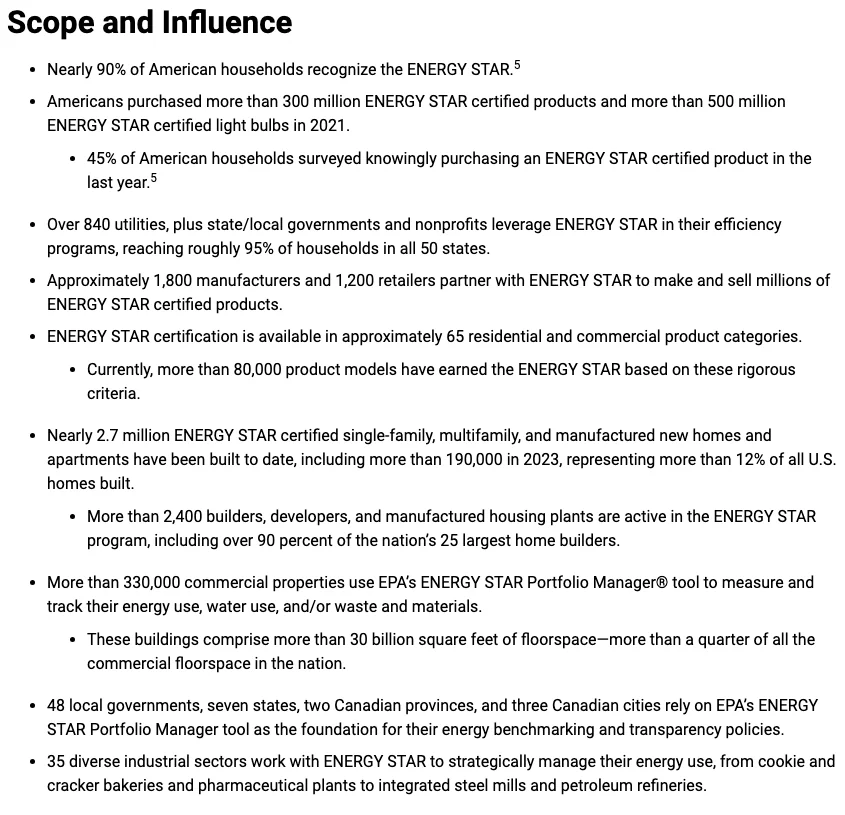
45% of households said they knowingly bought an ENERGY STAR labeled product in the previous 12 months (EPA, Nov 2023).
- 57% of those knowing buyers said the label was very or somewhat influential in their decision, a decline that began in 2015, and 33% were extremely likely to recommend ENERGY STAR products to a friend (EPA, Nov 2023).
- Americans bought more than 300 million certified products and more than 500 million certified light bulbs in 2021 (ENERGY STAR, Oct 2026).
- In 2019, for the first time, a majority of surveyed households reported buying a certified product, and cumulative purchases passed 7 billion (ENERGY STAR, Oct 2026).
How does that compare with the EU energy label?
75% of EU consumers use the energy label to get informed when they buy labelled products (European Commission, May 2024).
The US recognition figure in the Key Takeaways and the EU figures come from different surveys with different questions, so treat them as a rough comparison, not a ranking.
What Share of the Market Do ENERGY STAR Products Hold?
A label that covers nearly every dishwasher sold has done its job and has little left to sort. A label on 1% of televisions is a premium tier. The 2022 report is the newest edition we found on the ENERGY STAR site.
Which products are almost fully certified?
90% of dehumidifiers shipped in 2022 were certified, and so were 86% of room air cleaners and 66% of refrigerators, not counting compact models (ENERGY STAR, Sep 2023).
How much of the heating and cooling market is certified?
36% of residential gas furnaces shipped in 2022 were certified, about 1.41 million units, and so were 64% of residential gas boilers (ENERGY STAR, Sep 2023).
- 48% of room air conditioners shipped were certified, about 3.13 million units (ENERGY STAR, Sep 2023).
Where is the label rare?
Only 1% of televisions shipped in 2022 were certified (ENERGY STAR, Sep 2023).
- Certified heat pump water heaters and certified geothermal heat pumps were each 3% of their markets, about 141,000 and 30,000 units (ENERGY STAR, Sep 2023).
- The response rate among partners who had to report was 80% across 2,126 partners, and EPA does not adjust totals for the partners who did not respond (ENERGY STAR, Sep 2023).
How Many ENERGY STAR Homes and Buildings Exist?
The label reaches well past products. It also certifies new homes, commercial buildings and factories, and those programs have their own counts.
How many certified new homes are there?
Nearly 2.7 million certified new homes and apartments have been built, including more than 190,000 in 2023, which was more than 12% of all US homes built (ENERGY STAR, Oct 2026).
- More than 2,400 builders, developers and manufactured housing plants are active, including over 90 percent of the 25 largest home builders (ENERGY STAR, Oct 2026).
- EPA cites studies showing sales price premiums of up to 8% for certified and similarly efficient homes (ENERGY STAR, Oct 2026).
- The 45L builder tax credit is not allowed for homes acquired after June 30, 2026 (IRS, Aug 2025).
How many buildings use the commercial tools?
More than 330,000 commercial properties use the Portfolio Manager tool, covering more than 30 billion square feet, over a quarter of US commercial floorspace (ENERGY STAR, Oct 2026).
- A building needs a score of 75 or higher, which means it beats at least 75% of similar buildings nationwide (ENERGY STAR, Oct 2026).
What Appliances Do US Homes Already Own?
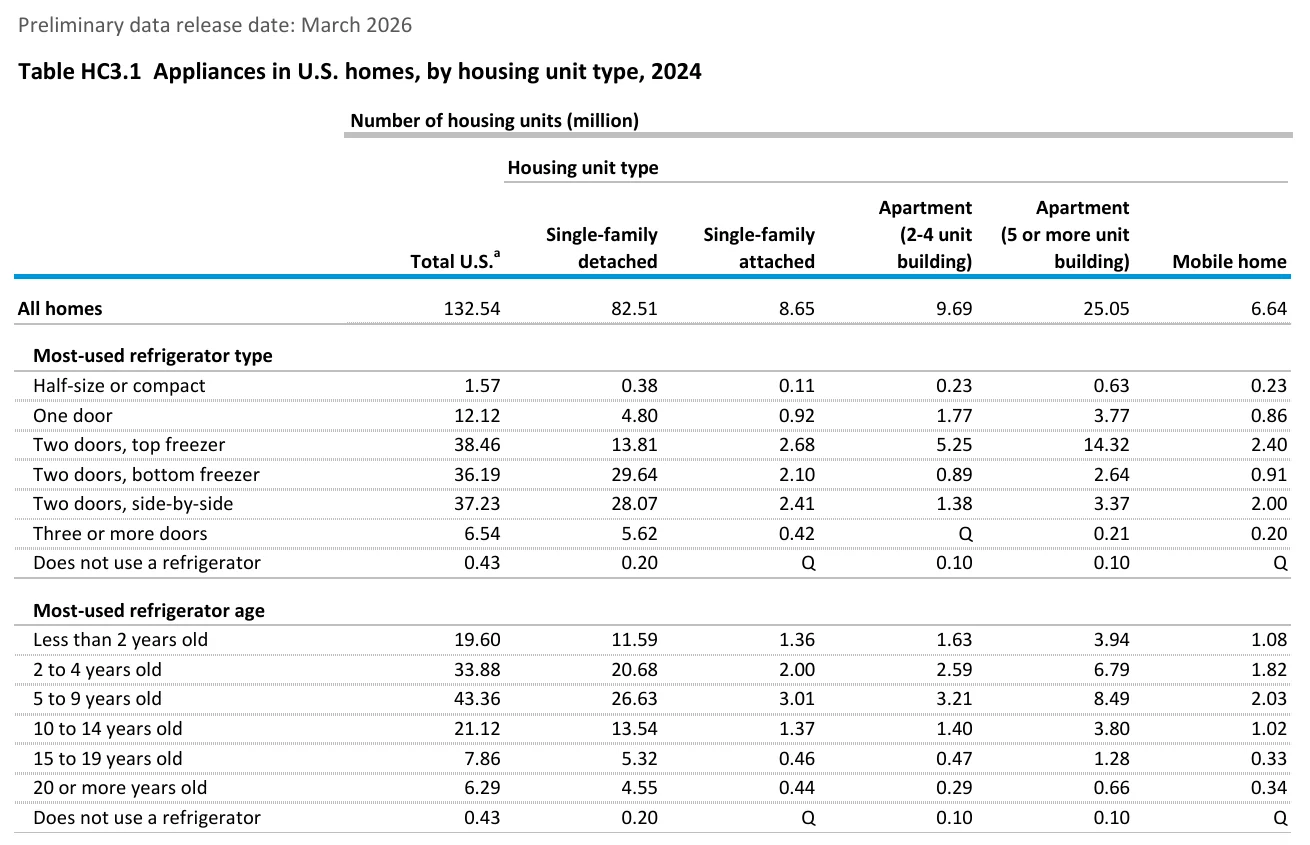
Most of the upgrade market is a stock problem. Homes already have the appliances, and the question is how old they are. EIA’s 2024 survey gives the counts.
How many homes own the big appliances?
The survey covers 132.54 million US homes, and 99.47 million of them have a dishwasher (EIA, Mar 2026).
- 112.99 million homes have a clothes washer, of which 79.48 million are top loaders and 33.51 million are front loaders (EIA, Mar 2026).
- 111.33 million homes have a clothes dryer, and 90.96 million of those dryers run on electricity (EIA, Mar 2026).
- 48.64 million homes use a separate freezer (EIA, Mar 2026).
How old are those appliances?
6.29 million homes use a most-used refrigerator that is 20 or more years old (EIA, Mar 2026).
- 7.86 million homes use a most-used refrigerator that is 15 to 19 years old (EIA, Mar 2026).
- 5.24 million dishwashers are 20 or more years old (EIA, Mar 2026).
- 5.46 million clothes dryers are 20 or more years old (EIA, Mar 2026).
Who lives with the oldest appliances?
43.00 million homes are renter-occupied (EIA, Mar 2026).
- 1.29 million homes built before 1950 still use a most-used refrigerator that is 20 or more years old (EIA, Mar 2026).
- 7.92 million homes with household income of $200,000 or more use a second refrigerator, against 0.81 million homes with income under $10,000 (EIA, Mar 2026).
How do households use them?
19.17 million homes with a dishwasher use it zero times per week (EIA, Mar 2026).
- Only 5.29 million homes say the energy saver cycle is their most-used dishwasher cycle (EIA, Mar 2026).
- 50.49 million homes usually wash clothes in cold water, and 8.43 million use hot (EIA, Mar 2026).
What do homes cook with?
68.56 million homes use an electric range as their most-used range, against 36.75 million that use natural gas (EIA, Mar 2026).
What about televisions?
35.21 million homes have a most-used television of 60 inches or more (EIA, Mar 2026).
- 7.33 million homes use five or more televisions (EIA, Mar 2026).
What Do ENERGY STAR Rebates and Tax Credits Pay?
The money rules changed in 2025 and 2026. Check the date before you quote a credit to a customer, because several have ended. The wider picture of upgrades and savings is in home energy efficiency statistics.
What did the federal tax credit pay for ENERGY STAR products?
Exterior doors that met ENERGY STAR requirements earned up to $250 per door and $500 in total (IRS, Apr 2026).
- Windows and skylights that met the ENERGY STAR Most Efficient requirements earned up to $600 in total (IRS, Apr 2026).
- Residential energy property that met the CEE highest efficiency tier earned up to $600 per item (IRS, Apr 2026).
What do the DOE home energy rebates pay?
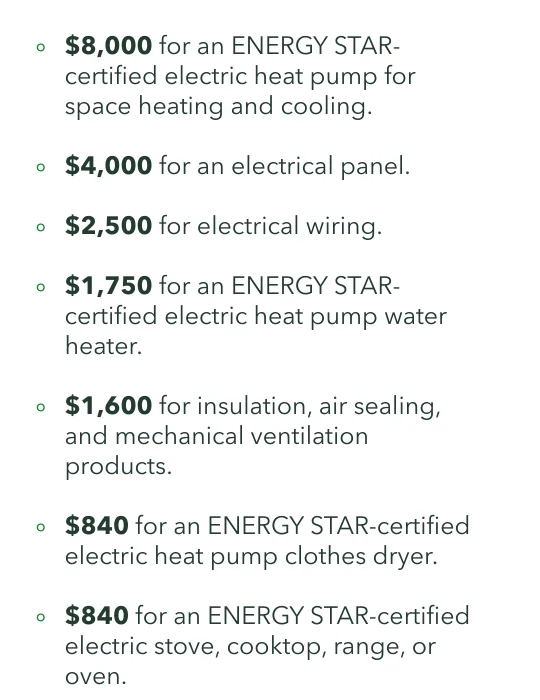
DOE’s fact sheet lists $1,750 for an ENERGY STAR certified heat pump water heater (DOE, Sep 2024).
- It lists $840 for an ENERGY STAR certified heat pump clothes dryer and $840 for an ENERGY STAR certified electric stove, cooktop, range or oven (DOE, Sep 2024).
- It lists $1,600 for insulation, air sealing and mechanical ventilation products (DOE, Sep 2024).
- States run the programs and choose which products qualify, so availability varies by state (DOE, Sep 2024).
How far do utility programs reach?
Over 840 utilities, plus state and local governments and nonprofits, use ENERGY STAR in their efficiency programs, reaching roughly 95% of households in all 50 states (ENERGY STAR, Oct 2026).
- CEE says its Tier 1 level, when it matches ENERGY STAR, targets the top 25% of models (CEE, Oct 2026).
- CEE’s latest industry report says US and Canadian electric and gas efficiency program spending rose one percent to $8.9 billion (CEE, Dec 2024).
Does the ENERGY STAR Label Change What People Buy?
Researchers find that the label does move some buyers, but not always toward the savings the label promises. The best studies use real purchase and billing data.
What do economists find about the label?
A structural model of the US refrigerator market puts the opportunity cost of imperfectly informed consumers at $12 to $17 per refrigerator sold (NBER, Mar 2014).
- Some consumers have a large willingness to pay for the label, well beyond the energy savings, while others pay attention to electricity costs and ignore the label (NBER, Mar 2014).
- A choice experiment found that the EnergyGuide label led to a one-third undervaluation of efficiency when a uniform 5 percent discount rate was used (NBER, Jul 2013).
- The same experiment found that labels endorsing a model with ENERGY STAR encouraged substantially higher energy efficiency (NBER, Jul 2013).
Do rebates deliver savings that would not happen anyway?
An additional 15 to 20 percent of rebate claimants only delayed their purchases by a few weeks (AEA, Nov 2017).
- Consumers responded to the rebates by upgrading to higher quality but less energy-efficient models (AEA, Nov 2017).
- Government spending per unit of energy saved was an order of magnitude higher than for other efficiency programs (AEA, Nov 2017).
Can You Trust the ENERGY STAR Label?
The label was once easy to game, and the rules changed after that. The 2010 GAO test is the best public evidence on the old weakness. Today’s checks are third-party certification, labs and post-market testing.
What did the GAO covert test find?
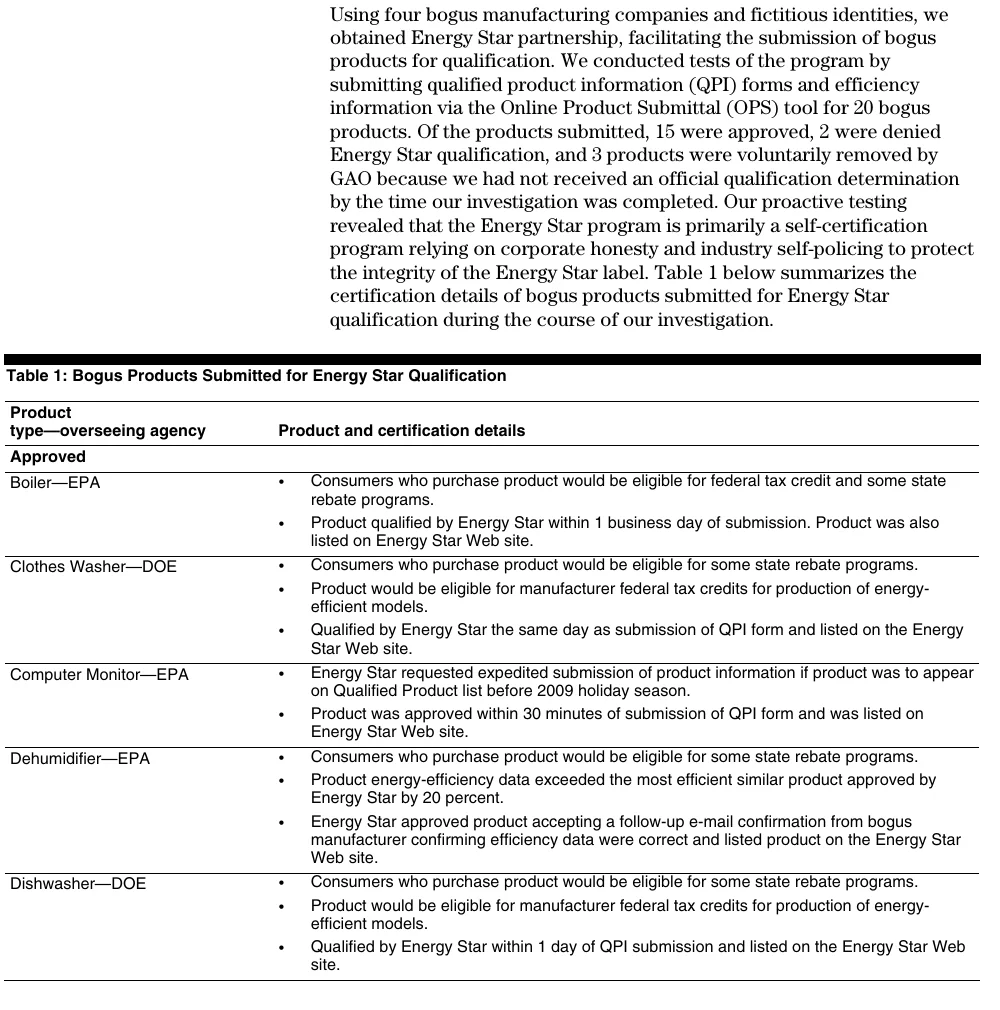
GAO used four bogus manufacturing firms to submit 20 fictitious products with fake energy savings claims (GAO, Mar 2010).
- Of the 20 products, 2 were denied and 3 were withdrawn by GAO before any decision (GAO, Mar 2010).
- Of the 16 products sent to EPA, 12 were approved, 1 was rejected and 3 never received a final answer (GAO, Mar 2010).
- A computer monitor was approved within 30 minutes of submission, and a refrigerator, a dishwasher and a clothes washer were approved within 1 day (GAO, Mar 2010).
- Two of the bogus firms received requests from real companies to buy products because the firms were listed as ENERGY STAR partners (GAO, Mar 2010).
- Of the 4 products sent to DOE, 3 were qualified and a compact fluorescent bulb was rejected for missing third-party test results (GAO, Mar 2010).
- Only 4 of the 20 products had to be verified by an independent third party (GAO, Mar 2010).
- About $300 million from the Recovery Act was set aside for state rebate programs on efficient products at the time (GAO, Mar 2010).
What checks exist today?
EPA says third-party certification began for more than 60 product categories in 2011 (ENERGY STAR, Oct 2026).
- EPA oversees more than twenty certification bodies and more than 700 recognized labs (ENERGY STAR, Oct 2026).
- Certification bodies must run post-market verification testing on a sample of certified products and report to EPA twice a year (EPA, Nov 2025).
Who Runs ENERGY STAR in 2026?
DOE is now the lead agency, and a 12 month handover from EPA is under way. The numbers below show what the handover covers.
What changed in 2026?
The agreement runs for 10 years, and either agency can leave with 365 days of written notice (EPA and DOE, Mar 2026).
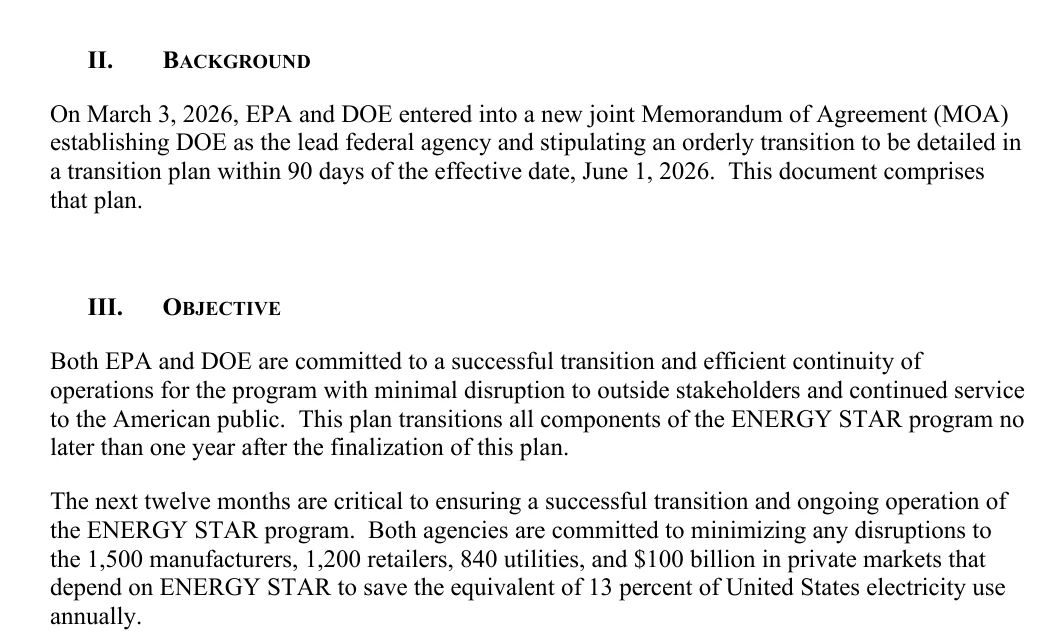
- The transition plan was finalized on August 28, 2026, and the agencies commit to finish no more than twelve months later (EPA and DOE, Aug 2026).
- The plan counts 1,500 manufacturers, 1,200 retailers, 840 utilities and $100 billion in private markets that depend on the label (EPA and DOE, Aug 2026).
What does the transition plan cover?
Moving the ENERGY STAR IT systems and data to DOE is targeted for completion before July 2027 (EPA and DOE, Aug 2026).
- EPA has not been engaged in updating specifications since early 2025, and DOE will review the open issues (EPA and DOE, Aug 2026).
- EPA has ENERGY STAR agreements with three countries, Canada, Switzerland and Japan (EPA and DOE, Aug 2026).
Methodology and Sources
Every figure comes from the group that produced it: EPA and DOE for program results, EIA for the housing survey, GAO for the 2010 test, the IRS for tax rules, CEE for the household survey, the European Commission for the EU label and peer-reviewed or working-paper economics for the research. Counts labeled as open data were pulled from the ENERGY STAR Product Finder files on October 20, 2026 with the file’s own query interface, and percentages are rounded shares of listed entries, not shares of sales. The citation date is the date of the source page or document. Pages without a printed date carry the October 2026 retrieval date. The page is refreshed monthly.
Sources
- AEA, Cash for Coolers: Evaluating a Large-Scale Appliance Replacement Program in Mexico (AEJ: Economic Policy), Nov 2014
- AEA, Consumers’ Response to State Energy Efficient Appliance Rebate Programs (AEJ: Economic Policy), Nov 2017
- CEE, Annual Industry Reports, Dec 2024
- CEE, CEE Tiers and ENERGY STAR, Oct 2026
- CEE, National Awareness of ENERGY STAR, Oct 2026
- DOE, Appliance and Equipment Standards Program fact sheet, Mar 2025
- DOE, Home Energy Rebates Frequently Asked Questions, Sep 2024
- EIA, Residential Energy Consumption Survey 2024, Table HC3.1 Appliances in U.S. homes, Mar 2026
- EIA, Residential Energy Consumption Survey 2024, Table HC3.2, Mar 2026
- EIA, Residential Energy Consumption Survey 2024, Table HC3.3, Mar 2026
- EIA, Residential Energy Consumption Survey 2024, Table HC3.5, Mar 2026
- EIA, Residential Energy Consumption Survey 2024, Table HC4.1 Electronics in U.S. homes, Mar 2026
- ENERGY STAR, Ceiling Fans, Oct 2026
- ENERGY STAR, Clothes Dryers, Oct 2026
- ENERGY STAR, Clothes Washers, Oct 2026
- ENERGY STAR, ENERGY STAR Certification, Oct 2026
- ENERGY STAR, ENERGY STAR Certified Homes, Features and Benefits, Oct 2026
- ENERGY STAR, ENERGY STAR Impacts, Oct 2026
- ENERGY STAR, HVAC Quality Installation, Oct 2026
- ENERGY STAR, Heat and Cool Efficiently, Oct 2026
- ENERGY STAR, Our History, Oct 2026
- ENERGY STAR, Refrigerators, Oct 2026
- ENERGY STAR, Unit Shipment and Market Penetration Report, Calendar Year 2022, Sep 2023
- ENERGY STAR open data, ENERGY STAR Certified Boilers, Oct 2026
- ENERGY STAR open data, ENERGY STAR Certified Furnaces, Oct 2026
- ENERGY STAR open data, ENERGY STAR Certified Heat Pumps, Oct 2026
- ENERGY STAR open data, ENERGY STAR Certified Light Commercial HVAC, Oct 2026
- ENERGY STAR open data, ENERGY STAR Certified Residential Dishwashers, Oct 2026
- ENERGY STAR open data, ENERGY STAR Certified Residential Refrigerators, Oct 2026
- ENERGY STAR open data, ENERGY STAR Certified Room Air Conditioners, Oct 2026
- ENERGY STAR open data, ENERGY STAR Certified Water Heaters, Oct 2026
- ENERGY STAR open data, ENERGY STAR Model Index, Oct 2026
- EPA, Information Collection Request, EPA’s ENERGY STAR Product Labeling (Renewal), Federal Register, Nov 2025
- EPA, National Awareness of ENERGY STAR for 2022: Analysis of 2022 CEE Household Survey, Nov 2023
- EPA, Proposed Information Collection Request, EPA’s ENERGY STAR Product Labeling (Renewal), Federal Register, Aug 2025
- EPA and DOE, 2026 ENERGY STAR Program Transition Plan, Aug 2026
- EPA and DOE, 2026 Memorandum of Agreement on the ENERGY STAR Program, Mar 2026
- European Commission, Understanding the Energy Label, May 2024
- GAO, Energy Star Program: Covert Testing Shows the Energy Star Program Certification Process Is Vulnerable to Fraud and Abuse (GAO-10-470), Mar 2010
- IRS, Energy Efficient Home Improvement Credit, Apr 2026
- IRS, FAQs for modification of sections 25C, 25D, 25E, 30C, 30D, 45L, 45W and 179D, Aug 2025
- NBER, How Consumers Respond to Environmental Certification and the Value of Energy Information (Working Paper 20019), Mar 2014
- NBER, Nudging Energy Efficiency Behavior: The Role of Information Labels (Working Paper 19224), Jul 2013
Glossary
- AFUE: annual fuel utilization efficiency, the share of fuel a furnace or boiler turns into heat.
- CEE: Consortium for Energy Efficiency, a group of efficiency program administrators.
- DOE: US Department of Energy.
- EIA: US Energy Information Administration.
- EPA: US Environmental Protection Agency.
- GAO: US Government Accountability Office.
- HSPF2 and SEER2: seasonal heating and cooling efficiency ratings under the 2023 test method.
- R-454B, R-410A and R-32: refrigerants used in heat pumps and air conditioners.
- RECS: the EIA Residential Energy Consumption Survey.