Propane statistics tell two stories. At home, propane is a rural heating and cooking fuel that a few million households buy by the truckload. Abroad, it is an export that leaves Gulf Coast terminals faster than at any time on record.
This page collects the primary figures in one place: homes, supply, exports, prices, safety, emissions and the companies that sell the gas. Each number comes from the agency, regulator, company filing or research body that produced it, with the date of the data beside it.
Heating contractors and homeowners will get the most from the first section, because the energy use of propane homes sets furnace and tank size. Every link was checked against the original page or file in October 2026, and the page is refreshed each month.
Key Takeaways
- The 2020 Residential Energy Consumption Survey counted 5.21 million US homes that use propane as their main heating fuel (EIA, Mar 2023).
- Rural US homes used 313 trillion Btu of propane in 2020, against 78 trillion Btu in urban homes (EIA, Mar 2024).
- Natural gas plants made 2,307 thousand barrels of propane a day in 2025, up from 1,682 in 2020 (EIA, Sep 2026).
- US propane exports hit a record 2.1 million barrels a day in April 2026 (EIA, Oct 2026).
- The US average residential propane price was $2.638 a gallon on October 12, 2026, 21.3 cents above a year earlier (EIA, Oct 2026).
- Residential propane cost $4.233 a gallon in Connecticut and $1.647 in North Dakota on the same day (EIA, Oct 2026).
- US retail propane sales for non-chemical uses totaled about 8.8 billion gallons in 2024, per a Propane Education and Research Council survey cited by UGI (UGI, Nov 2025).
- The consumer price index for propane, kerosene and firewood stood at 413.8 in September 2026, against a series high of 475.0 in March 2022 (BLS, Oct 2026).
- EU households burned 4,648.9 thousand tonnes of liquefied petroleum gas in 2024 (Eurostat, Oct 2026).
- Gas grills were involved in an average of 9,235 US home fires a year from 2020 to 2024 (NFPA, May 2026).
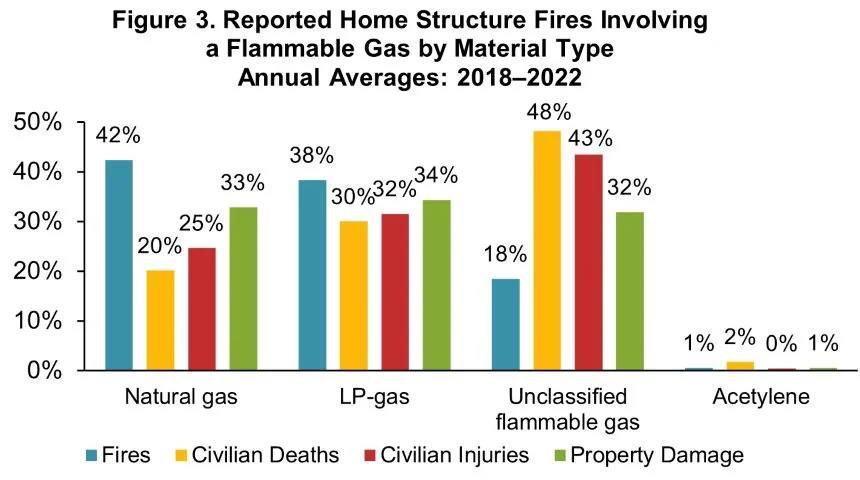
- LP-gas started 38% of US home structure fires involving flammable gas and caused 30% of the civilian deaths, while natural gas started 42% of the fires and caused 20% of the deaths (2018 to 2022) (NFPA, Oct 2024).
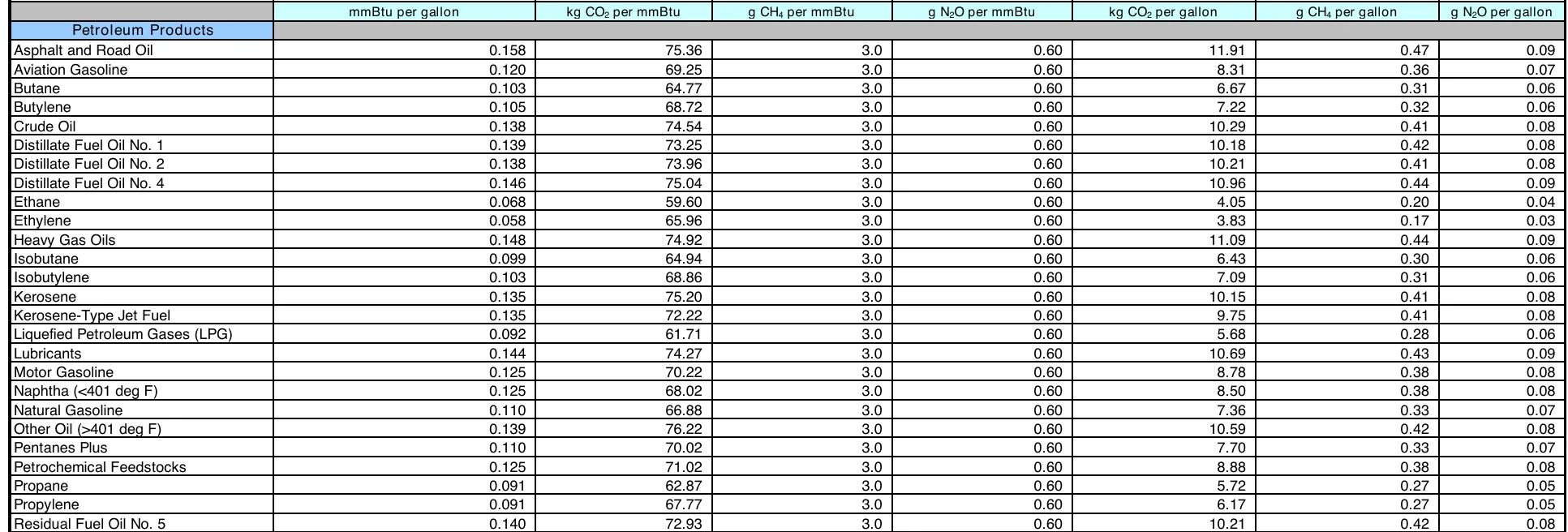
- Burning one gallon of propane releases 5.72 kilograms of carbon dioxide (EPA, Jan 2025).
- India had released 105,685,306 LPG connections under its Ujjwala scheme by September 23, 2026 (PMUY, Sep 2026).
- The US has 2,572 propane vehicle fueling stations, and 2,151 of them are primary fueling sites (AFDC, Oct 2026).
Propane Heating in US Homes
Propane heats a small slice of the country, and the slice is cold and rural. That is why each propane home matters more to a heating contractor than its share of the count suggests.
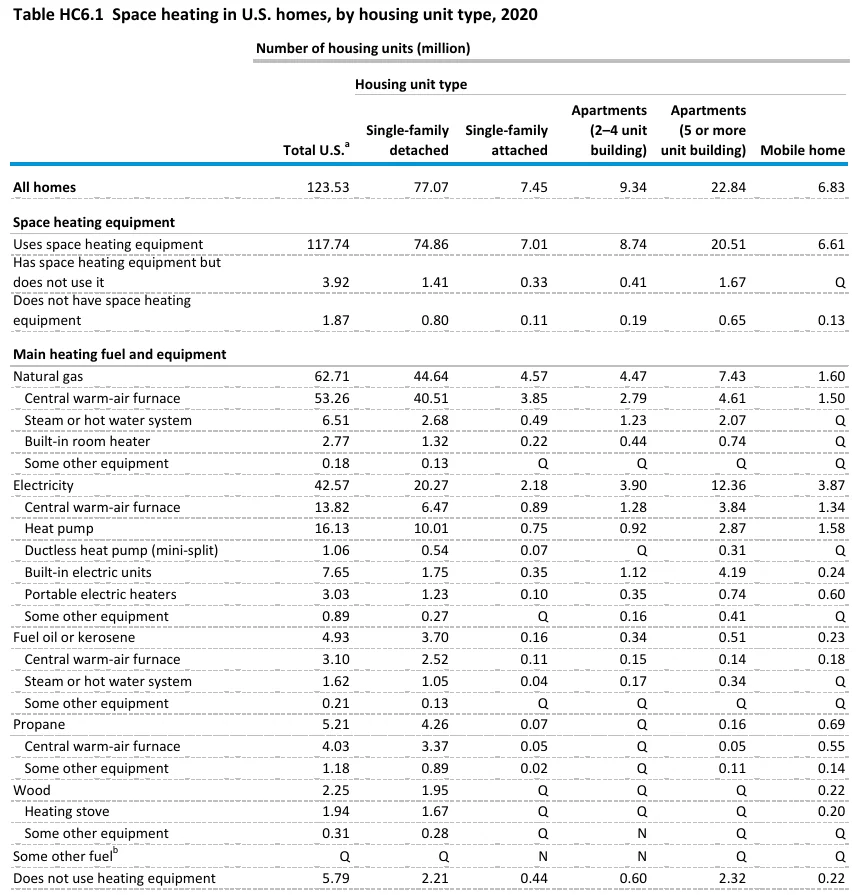
How many US homes heat with propane?
The Census Bureau’s 2023 survey counted 6,622,726 of 131,332,360 occupied US homes that used bottled, tank or LP gas as their main heating fuel (Census Bureau, Sep 2024).
The Census count and the energy survey count come from different surveys and different years, so treat them as two views of the same fuel, not one trend. The 2024 national count is on the heating page.
- The 2020 federal survey of home energy use found 7.68 million homes that use propane for space heating as a main or secondary source (EIA, Mar 2023).
- Single-family detached houses held 4.26 million of the homes where propane is the main fuel (EIA, Mar 2023).
- Equipment other than a central warm-air furnace heated 1.18 million of the main-fuel homes (EIA, Mar 2023).
Which states rely on propane heat the most?
Vermont had 56,523 propane-heated homes out of 285,548 in 2024 (Census Bureau, Sep 2025).
Share and count tell different stories. Northern New England and the Dakotas lean hardest on propane, while California and New York have more propane homes because they have more homes.
- Maine had 98,171 of 615,235 (Census Bureau, Sep 2025).
- South Dakota had 60,144 of 382,302 (Census Bureau, Sep 2025).
- California had the largest count of any state, 401,981 homes out of 13,797,638 (Census Bureau, Sep 2025).
- New York followed with 370,910 and Michigan with 361,091 (Census Bureau, Sep 2025).
Which kinds of homes use propane heat?
Very cold and cold climates held 2.93 million of the homes that heat mainly with propane in 2020 (EIA, Mar 2023).
Propane homes cluster in cold climates and in rural areas, and most are houses that their owners live in.
- Mobile homes accounted for 0.69 million of them (EIA, Mar 2023).
- Homeowners ran 4.55 million of these homes and renters 0.66 million (EIA, Mar 2023).
How much energy does a propane-heated home use?
Homes that heat mainly with propane used 98.2 million Btu of energy each in 2020, across all fuels and uses (EIA, Mar 2024).
A home’s heating load, not its fuel, decides furnace size. Start with the BTU calculator for a first load estimate, then use the furnace sizing calculator to turn the load into a furnace size.
- Those homes spent a combined $13.94 billion on all household energy (EIA, Mar 2024).
- Total propane use in US homes came to 391 trillion Btu (EIA, Mar 2024).
- A Midwest home that uses propane burned 62.8 million Btu of it in 2020, against 20.9 million Btu in the South (EIA, Mar 2024).
Propane Uses Beyond Heating
Heating is only one job for propane. It also cooks, heats water, fires grills and fuels vehicles, and the customer mix looks very different at a retailer than in a household survey.
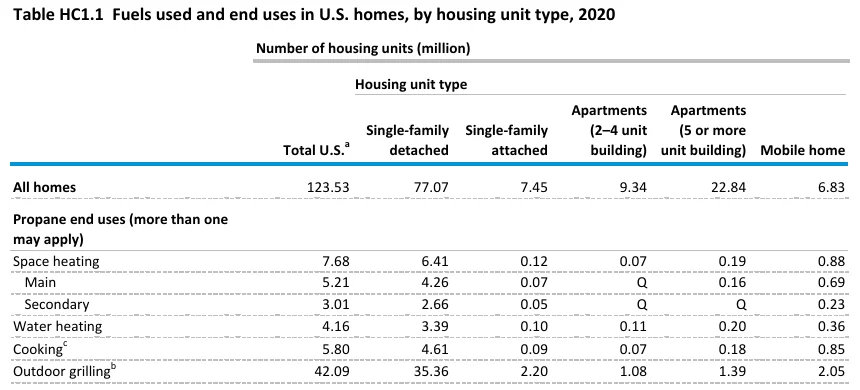
What else do US homes use propane for?
In 2020, 11.14 million US homes used propane for at least one purpose (EIA, Mar 2023).
Grilling reaches far more homes than heating, which is why propane shows up in many households that never order a bulk delivery.
- Cooking took it in 5.80 million homes (EIA, Mar 2023).
- A propane unit was the main water heater in 4.12 million homes (EIA, Mar 2023).
- Outdoor grilling used propane in 42.09 million homes (EIA, Mar 2023).
Who buys propane from retailers?
Of the retail propane gallons Suburban Propane sold in fiscal 2025, 43% went to residential customers, 39% to commercial, 8% to industrial, 6% to government and 4% to agriculture (Suburban Propane, Nov 2025).
Retailers define customer groups differently, so compare the two lines with care. AmeriGas reports motor fuel as its own group, while Suburban Propane folds engine fuel into industrial.
- UGI says residential customers took 28% of AmeriGas retail gallons in fiscal 2025, commercial and industrial 42%, motor fuel 22% and agriculture 3% (UGI, Nov 2025).
How much propane do vehicles use?
Transportation took less than 1% of all US propane consumption in 2022 (EIA, Dec 2023).
Vehicle use is a niche, mostly in fleets. A gallon of propane holds less heat than a gallon of gasoline, so compare cost per Btu, not per gallon.
- Texas has 330 propane stations, including 252 primary fueling sites (AFDC, Oct 2026).
- California has 198 propane stations (AFDC, Oct 2026).
- Oklahoma has 136 (AFDC, Oct 2026).
- Propane averaged $3.59 a gallon as a vehicle fuel from April 1 to April 15, 2026, against $4.09 for gasoline and $5.55 for diesel (AFDC, Apr 2026).
US Propane Supply, Stocks and Demand
The United States makes far more propane than it burns. Production keeps rising, and stocks decide how the winter feels.
How much propane does the US make?
EIA forecasts that US gas plants will make 2.42 million barrels of propane a day in 2026 and 2.59 million in 2027 (EIA, Oct 2026).
Most propane comes out of natural gas processing plants, which strip it from wet gas. More gas drilling means more propane, whether or not anyone needs it for heat.
- Refineries and blenders add a smaller stream of about 0.28 million barrels of propane a day (EIA, Oct 2026).
- Weekly propane and propylene production was 2.898 million barrels a day in the week ended October 9, 2026, up 0.089 from a year earlier (EIA, Oct 2026).
- Suburban Propane buys from about 45 wholesalers at about 140 supply points in the United States and Canada (Suburban Propane, Nov 2025).
- About 85% of its propane purchases came from domestic suppliers in fiscal 2025, and all of it came from North America (Suburban Propane, Nov 2025).
- Enterprise says its Dixie Pipeline carries propane through seven states and connects to eight propane terminals it owns (Enterprise Products, Feb 2026).
How much propane is in storage?
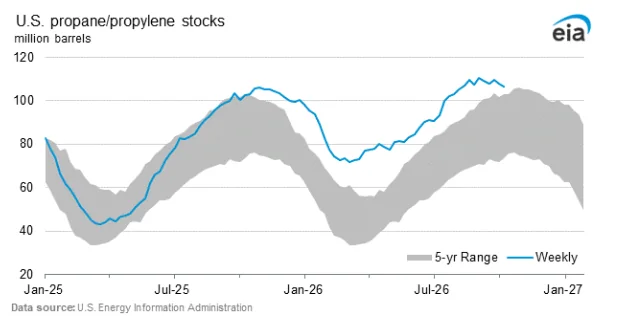
US propane and propylene stocks stood at 106.375 million barrels on October 9, 2026, which is 3.999 million barrels more than a year earlier (EIA, Oct 2026).
Stocks build through the summer and fall through the winter, as the chart shows. Canada follows the same cycle.
- Weekly demand, measured as product supplied, was 1.209 million barrels a day that week, up 0.714 from a year earlier (EIA, Oct 2026).
- Canadian underground propane stocks were 1,561 thousand cubic meters (9.82 million barrels) on November 1, 2025, which is 19.7% below the five-year average (CER, Dec 2025).
- Ontario stocks were 30.6% below their five-year average (CER, Dec 2025).
How much propane does the US consume?
US propane product supplied averaged 883 thousand barrels a day in 2025, up from 780 thousand in 2023 (EIA, Sep 2026).
Product supplied is the standard stand-in for demand. It measures what left the supply system, not what a meter counted.
- EIA expects propane consumption to fall to 0.79 million barrels a day in 2026 (EIA, Oct 2026).
- Propane is stored as a liquid because it takes up 270 times less space than it does as a gas (EIA, Dec 2023).
Propane Exports and Global LPG Demand
Exports are where propane growth is now. Asian and European buyers pull cargoes from the Gulf Coast, and the shipping data shows it.
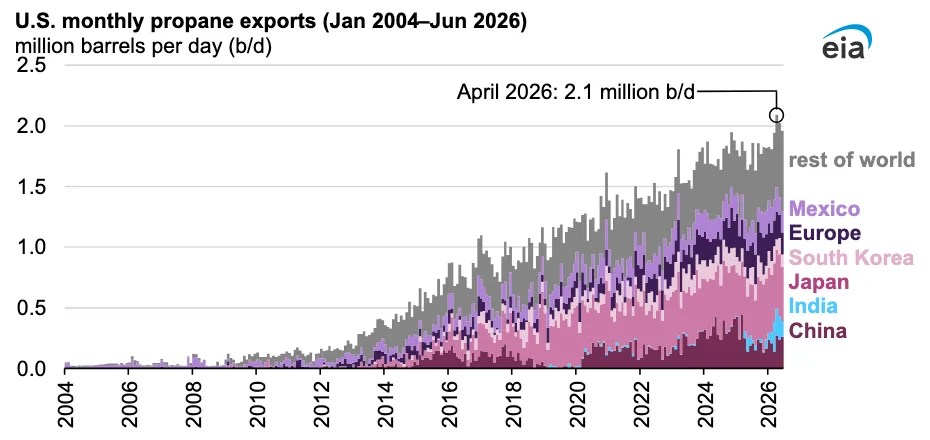
How much propane does the US export?
US propane exports averaged 1,775 thousand barrels a day in 2025, up from 1,262 thousand in 2020 (EIA, Sep 2026).
EIA warns that export capacity limits could slow further growth, which is why terminal expansions matter.
- Exports averaged 2 million barrels a day in the first half of 2026, 11% more than a year earlier (EIA, Oct 2026).
- Exports to China were down 28% in 2025 from 2024 after China put a 10% tariff on US propane in February 2025 (EIA, Oct 2026).
- China raised that tariff to 125% for April 2025 and has held it at 10% since May 2025 (EIA, Oct 2026).
- Exports to China fell another 19% in the first half of 2026 (EIA, Oct 2026).
- Enterprise says its Enterprise Hydrocarbons Terminal can load about 835 thousand barrels a day of LPG (Enterprise Products, Feb 2026).
- A fourth refrigeration train due by the end of 2026 adds about 300 thousand barrels a day of propane and butane export capacity (Enterprise Products, Feb 2026).
How much LPG do European homes burn?
Italy used 963.6 thousand tonnes of LPG in households in 2024, the most of any EU country (Eurostat, Oct 2026).
Eurostat reports liquefied petroleum gas, which is propane, butane or a mix of the two, so its numbers include butane as well as propane.
- Germany used 838.0 thousand tonnes (Eurostat, Oct 2026).
- Spain used 736.9 thousand tonnes (Eurostat, Oct 2026).
- France used 591.1 thousand tonnes (Eurostat, Oct 2026).
- EU households used 4,387.2 thousand tonnes in 2023, so the 2024 total rose (Eurostat, Oct 2026).
- All EU final consumption of LPG came to 14,566.7 thousand tonnes in 2024 (Eurostat, Oct 2026).
- UGI International sold about 820 million gallons of LPG across Europe in fiscal 2025 (UGI, Nov 2025).
How far has LPG reached in India?
Another 2,442,525 connections were released under the latest Ujjwala extension (PMUY, Sep 2026).
LPG in India reaches households through a government connection scheme, so the counts below track household reach, not tonnes.
- In fiscal 2024-25 oil marketing companies ran free door-to-door safety checks that covered about 12.12 crore households (PMUY, Sep 2026).
- They replaced 4.65 crore old or spurious LPG hoses (PMUY, Sep 2026).
Propane Prices and Heating Costs
Propane is sold by the gallon, by truck, with no rate regulator. Price swings reach homes fast, and they differ a lot by region.
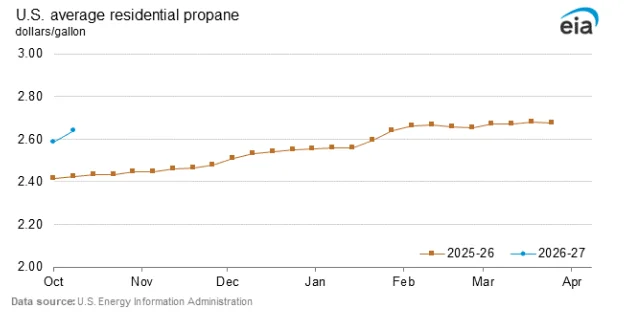
What do homes pay for propane right now?
On October 12, 2026 the East Coast average residential price was $3.647 a gallon, while the Midwest average was $2.112 (EIA, Oct 2026).
These are retail prices excluding taxes. The gap between regions is wider than the gap between years.
- New England paid $3.775, up 33.3 cents from a year earlier (EIA, Oct 2026).
- The Gulf Coast paid $2.940 and the Rocky Mountain region $2.283 (EIA, Oct 2026).
- The US average wholesale propane price was $1.153 a gallon, up 33.8 cents from a year earlier (EIA, Oct 2026).
How high have propane prices gone?
In the fourth week of January 2014 the US average residential price reached a record of more than $4.00 a gallon, almost 75% above the same week of 2013 (EIA, Oct 2023).
EIA ties the 2013-14 spike to a late corn harvest, cold wet weather and supply bottlenecks. The consumer price index shows the longer view.
- The Midwest average reached nearly $4.20 a gallon, 137% higher than a year before (EIA, Oct 2023).
- The consumer price index for propane, kerosene and firewood stood at 308.2 in August 2020 (BLS, Oct 2026).
- It stood at 406.2 in September 2025 (BLS, Oct 2026).
How does winter weather move propane sales?
Suburban Propane sells about two thirds of its retail propane volume in the six months from October through March (Suburban Propane, Nov 2025).
Winter sets the sales calendar, and the weather swings volumes from year to year.
- Ferrellgas sold about 56% of its propane volume in the five-month winter heating season in fiscal 2026 (Ferrellgas, Sep 2026).
- Ferrellgas sold 760 million gallons of propane in fiscal 2026 and 784 million in fiscal 2025 (Ferrellgas, Sep 2026).
- Over the western half of the US, fiscal 2026 heating degree days were 16% warmer than normal, by Ferrellgas’s reading of AccuWeather data (Ferrellgas, Sep 2026).
- UGI says retail propane industry volumes have been flat for several years (UGI, Nov 2025).
Propane Safety: Fires, Leaks and Grills
The fire data show where propane goes wrong: leaks, dirty grills and gas that escapes. Fire reports often cannot split propane from natural gas, so read these as gas figures.
How many home fires involve gas grills?
Fire departments responded to 12,141 home fires a year involving grills, hibachis or barbecues from 2020 to 2024 (NFPA, May 2026).
NFPA counts all gas grills, natural gas models included, so these figures set an upper bound for propane grills alone.
- That total includes 6,110 structure fires and 6,031 outside or unclassified fires (NFPA, May 2026).
- The fires caused 15 civilian deaths, 171 injuries and $241 million in direct property damage a year (NFPA, May 2026).
- Seventy-six percent of grill fires involved gas grills and 13% involved charcoal or other solid fuel (NFPA, May 2026).
- Gas grills caused 4,662 structure fires and 4,573 outdoor fires a year (NFPA, May 2026).
- Leaks or breaks caused 6% of gas grill structure fires and 13% of outside gas grill fires (NFPA, May 2026).
- One fifth of all grilling fires were traced to grills that had not been cleaned (NFPA, May 2026).
How dangerous are LP-gas fires?
US fire departments reported an average of 15,941 structure fires a year in which a flammable gas was the first material ignited, from 2018 to 2022 (NFPA, Oct 2024).
NFPA’s report groups LP-gas with other flammable gases. It says incidents involving LP-gas appeared more deadly than incidents involving other flammable gases.
- Those fires caused 191 civilian deaths and 747 injuries a year (NFPA, Oct 2024).
- They also caused $402 million in property damage a year (NFPA, Oct 2024).
- An estimated 10,774 of those fires happened in homes and 5,166 in other structures (NFPA, Oct 2024).
- LP-gas caused 32% of civilian injuries and 34% of property damage in home structure fires involving flammable gas (NFPA, Oct 2024).
- Where leaks, breaks or equipment failures were the reported factor in home gas fires, cooking equipment was involved 48% of the time and heating equipment 24% (NFPA, Oct 2024).
- Of the home gas fires that started outside, 75% involved grills (NFPA, Oct 2024).
- Where gas was uncontained, 27% of the deaths involved heaters and 26% involved water heaters (NFPA, Oct 2024).
Propane Emissions and Fuel Properties
Per unit of heat, propane sits between natural gas and the oil fuels. The federal factors below let you check that yourself.
How much carbon dioxide does propane release?
Propane gives off 62.87 kilograms of carbon dioxide per million Btu (EPA, Jan 2025).
Kerosene is the dirtiest of these fuels per Btu, and ethane and propane are among the cleaner ones. Natural gas is cleaner still, as the natural gas page shows.
- No. 2 distillate fuel oil gives off 73.96 (EPA, Jan 2025).
- Butane gives off 64.77 (EPA, Jan 2025).
- Ethane gives off 59.60 (EPA, Jan 2025).
- Kerosene gives off 75.20 (EPA, Jan 2025).
How much heat is in a gallon of propane?
A gallon of propane holds 0.091 million Btu of heat, against 0.125 for motor gasoline and 0.138 for No. 2 distillate (EPA, Jan 2025).
Compare fuels per Btu, not per gallon. To turn a heating load into gallons, divide the load by the heat in a gallon and by the efficiency of the equipment.
- Burning a gallon of propane releases 0.27 grams of methane and 0.05 grams of nitrous oxide (EPA, Jan 2025).
- Consumer-grade propane is at least 90% propane by volume, and the California grade may carry up to 10% propylene (EIA, Dec 2023).
Is renewable propane growing?
Suburban Propane sold more than 2.0 million gallons of renewable propane in fiscal 2025, mostly for transport and forklifts in California (Suburban Propane, Nov 2025).
Renewable propane moves through the same tanks and trucks as the fossil product. Volumes are still small next to the fossil supply.
- It has contracted for over 10.0 million gallons a year of renewable propane supply (Suburban Propane, Nov 2025).
The Propane Industry, Tanks and Delivery
A few large firms deliver a big share of the gas, and thousands of small dealers deliver the rest. The tank and truck sizes below are the equipment facts a tech needs on a service call.
How big is the US propane retail market?
The ten largest propane retailers account for about 33% of domestic retail sales, by UGI’s reading of 2024 industry rankings (UGI, Nov 2025).
The market is concentrated at the top and fragmented below. UGI and Suburban Propane both describe thousands of small independent dealers.
- Suburban Propane puts that share at about 35%, based on a 2023 industry sales report (Suburban Propane, Nov 2025).
- AmeriGas, UGI’s propane arm, serves over 1.0 million customers from about 1,390 locations (UGI, Nov 2025).
- It distributed about 801 million gallons in fiscal 2025, 92% of it to retail accounts (UGI, Nov 2025).
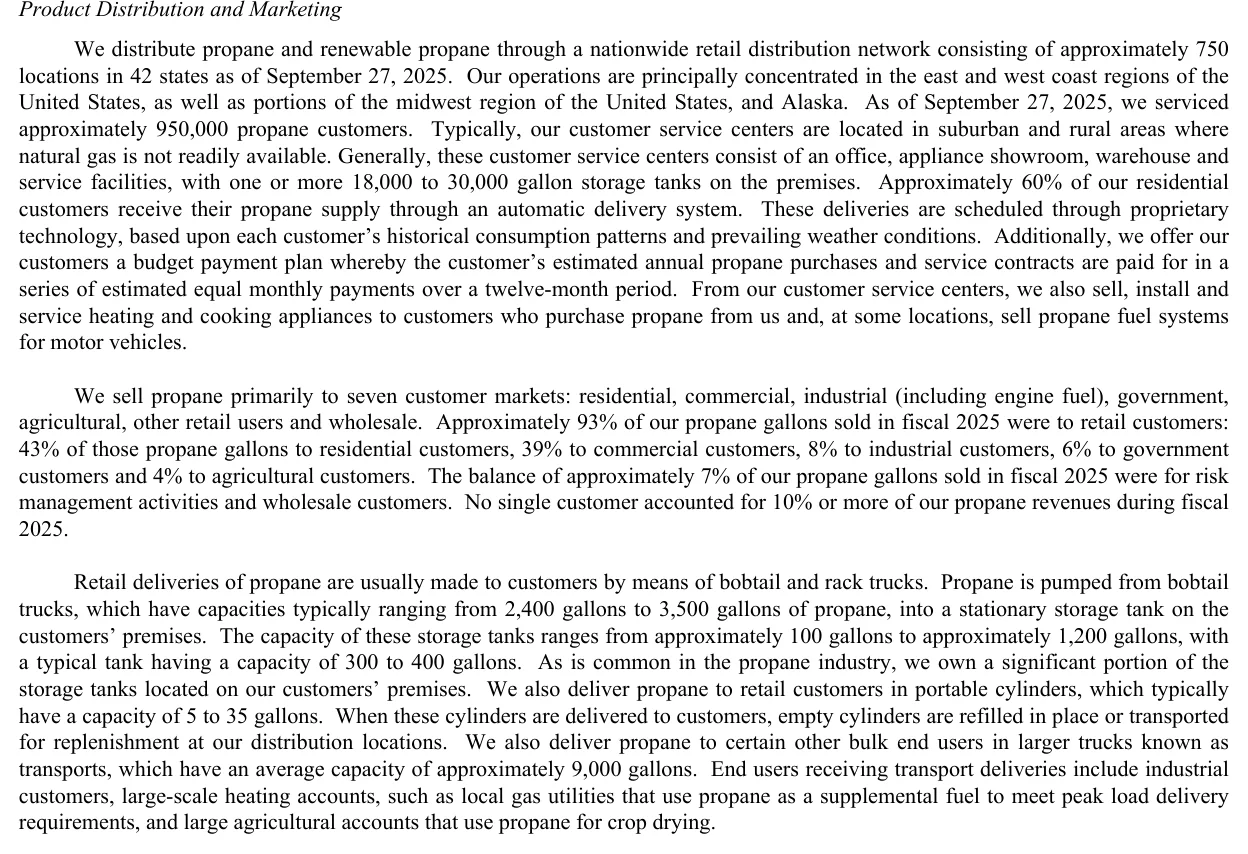
- Suburban Propane runs about 750 locations in 42 states and serves about 950,000 customers (Suburban Propane, Nov 2025).
- Ferrellgas had 1,055 propane distribution locations on July 31, 2026 (Ferrellgas, Sep 2026).
- US fuel dealers, a group that includes propane and heating oil sellers, ran 7,561 private establishments in 2024 (BLS, Sep 2025).
- They employed 69,636 people (BLS, Sep 2025).
- They paid $5.10 billion in wages, an average of $73,245 a worker (BLS, Sep 2025).
How big are propane tanks and delivery trucks?
Customer tanks at Suburban Propane hold about 100 to 1,200 gallons, and a typical tank holds 300 to 400 gallons (Suburban Propane, Nov 2025).
Tank size is what a delivery driver and a furnace tech both plan around. Bulk trucks fill stationary tanks, and cylinders serve smaller jobs.
- Its bobtail delivery trucks hold 2,400 to 3,500 gallons (Suburban Propane, Nov 2025).
- UGI says AmeriGas tanks run from about 120 to about 1,200 gallons, and its bobtails hold 2,400 to 3,000 gallons (UGI, Nov 2025).
- Ferrellgas bulk delivery trucks carry tanks of 2,600 to 3,500 gallons (Ferrellgas, Sep 2026).
- Suburban Propane’s portable cylinders hold 5 to 35 gallons (Suburban Propane, Nov 2025).
- Its large transport trucks carry about 9,000 gallons (Suburban Propane, Nov 2025).
- Tanks can run as large as 90,000 gallons at industrial sites (EIA, Dec 2023).
Who owns the tanks and how does delivery work?
About 70% of Ferrellgas residential customers use its equipment, and the rest own their tanks (Ferrellgas, Sep 2026).
Owning the tank helps hold the customer. Ferrellgas says rental terms and fire safety rules in some states require rented tanks to be filled only by their owner.
- Ferrellgas owned about 0.7 million customer tanks and 4.1 million portable cylinders (Ferrellgas, Sep 2026).
- It owned 38.5 million gallons of storage capacity and leased another 33.1 million gallons (Ferrellgas, Sep 2026).
- About 60% of Suburban Propane’s residential customers get automatic deliveries (Suburban Propane, Nov 2025).
- UGI says its ACE exchange cylinders were sold at over 41,500 retail locations on September 30, 2025 (UGI, Nov 2025).
Methodology and Sources
Every figure comes from the body that produced it: federal statistical agencies, the Census Bureau, Eurostat, the Canada Energy Regulator, India’s government scheme site, and company annual reports filed with the US Securities and Exchange Commission. Where a company filing quotes an industry survey, such as the retail sales and top-ten shares from the Propane Education and Research Council, the line names the filing, because the council’s own site blocks automated reading. We opened each page or file in October 2026 and took each number from the saved text. The LP-gas shares of fires, deaths, injuries and damage were read from the labels printed on the source chart in Figure 6. Surveys differ in year and definition, so a Census count and an energy-survey count are not the same measure. Related pages: heating, natural gas, space heaters and HVAC energy use. The page is refreshed monthly.
Sources
- EIA, Residential Energy Consumption Survey 2020, Table HC6.1
- EIA, Residential Energy Consumption Survey 2020, Table CE2.1
- EIA, U.S. Natural Gas Plant Field Production (annual)
- EIA, Today in Energy: U.S. exports of propane reached records in the first half of 2026
- EIA, Heating Oil and Propane Update
- UGI Corporation, Form 10-K for fiscal 2025
- BLS, Consumer Price Index, Propane, kerosene, and firewood (CUUR0000SEHE02)
- Eurostat, Oil and petroleum products supply, transformation and consumption (nrg_cb_oil)
- NFPA, U.S. grilling fires peak during warmer months (news release)
- NFPA, Structure Fires Involving Flammable Gases
- EPA, Emission Factors for Greenhouse Gas Inventories (2025)
- Government of India, Pradhan Mantri Ujjwala Yojana
- DOE Alternative Fuels Data Center, Alternative Fueling Station Counts by State
- Census Bureau, American Community Survey 2023 1-year, Table B25040 House Heating Fuel
- EIA, Residential Energy Consumption Survey 2020, Table HC1.1
- Census Bureau, American Community Survey 2024 1-year, Table B25040 House Heating Fuel
- EIA, Residential Energy Consumption Survey 2020, Table HC1.6
- EIA, Residential Energy Consumption Survey 2020, Table HC1.2
- EIA, Residential Energy Consumption Survey 2020, Table CE1.1
- EIA, Residential Energy Consumption Survey 2020, Table HC8.1
- Suburban Propane Partners, Form 10-K for fiscal 2025
- EIA, Uses of hydrocarbon gas liquids: propane in depth
- DOE Alternative Fuels Data Center, Alternative Fuel Price Report, April 2026
- EIA, Short-Term Energy Outlook, October 2026
- Enterprise Products Partners, Form 10-K for 2025
- Canada Energy Regulator, Market Snapshot: Low propane inventories and plentiful natural gas stocks ahead of winter
- EIA, U.S. Product Supplied for Crude Oil and Petroleum Products (annual)
- EIA, Uses of hydrocarbon gas liquids
- EIA, U.S. Exports of Crude Oil and Petroleum Products (annual)
- EIA, Prices for hydrocarbon gas liquids: propane prices
- Ferrellgas Partners, Form 10-K for fiscal 2026
- BLS, Quarterly Census of Employment and Wages, 2024 annual, NAICS 457210 Fuel dealers
- EIA, Transporting and storing hydrocarbon gas liquids
Glossary
- Btu: British thermal unit, a measure of heat. One million Btu is written mmBtu or MMBtu.
- b/d: Barrels per day. A barrel holds 42 US gallons.
- Bobtail: A delivery truck that pumps propane into a customer’s tank.
- LPG and LP-gas: Liquefied petroleum gas: propane, butane or a mix of the two. US retail LPG is almost all propane.
- Product supplied: EIA’s measure of what left the supply system, used as a stand-in for demand.
- RECS: The federal Residential Energy Consumption Survey, run by EIA. The latest edition covers 2020.
- ACS: The Census Bureau’s American Community Survey.
- PADD: Petroleum Administration for Defense District, one of five US regions EIA uses for fuel data.
- CPI: Consumer price index from the Bureau of Labor Statistics.
- Crore: An Indian unit equal to 10 million.
- HHV: Higher heating value, the heat content EPA lists for each fuel.
- Primary and secondary station: AFDC calls a propane station primary if it offers vehicle-specific fueling and secondary if fuel is available for vehicles with limited fueling services.